A strong social media strategy for injectors is not “post every day,” chase trending audio, or try to become an influencer. It is a repeatable system for becoming easier to discover, understand, and trust.
Start by deciding who you want to reach and what you want to be known for. Then create useful content that educates, demonstrates your professionalism, builds genuine connection, and gives interested people an appropriate next step. Measure conversations and meaningful actions—not follower count alone.
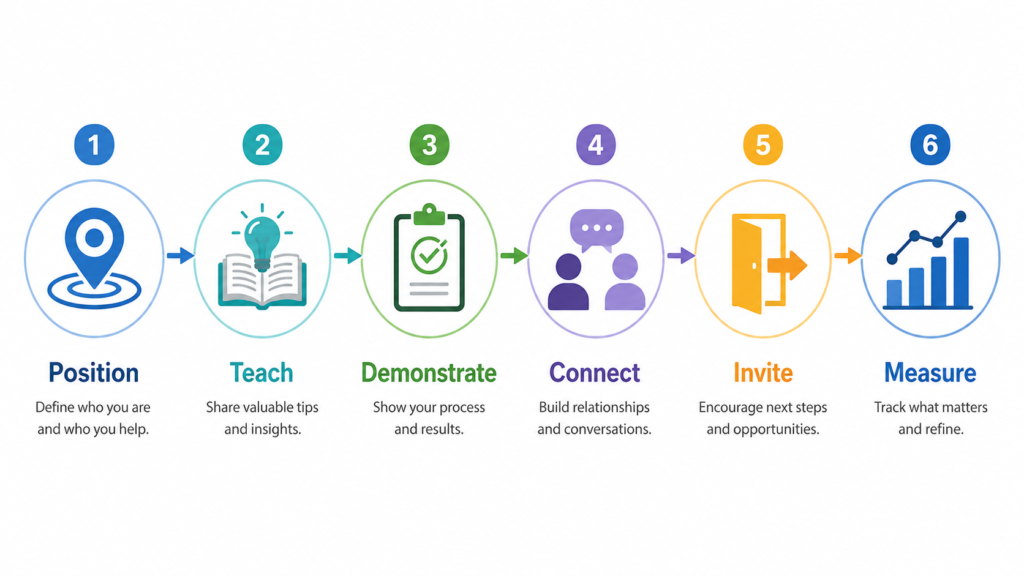
The framework is simple:
Position → Teach → Demonstrate → Connect → Invite → Measure
Social media should support your reputation and career.
It should not become your career.
1. Position Yourself Before You Start Posting
The first question is not, “What should I post?”
It is:
What do I want the right people to know me for?
Without that answer, your feed becomes a collection of unrelated treatment photos, trending sounds, inspirational quotes, promotions, and whatever seemed like a good idea that morning.
That is activity.
It is not strategy.
Your positioning does not have to be complicated. Decide:
- Who you most want your content to help.
- Which professional strengths you want associated with your name.
- Which topics you can speak about accurately and confidently.
- What type of patient or professional relationship you want the content to support.
- How your personal presence fits with your employer or practice brand.
You might want to become known for clear patient education, natural-looking outcomes, thoughtful consultations, a particular professional interest, patient communication, or simply making aesthetics easier to understand.
Do not invent expertise to create a niche.
Build your positioning around the professional value you can genuinely deliver.
2. You Do Not Need to Be Everywhere
Instagram, TikTok, Facebook, LinkedIn, and YouTube can all serve different purposes.
That does not mean you need all five.
Start with the platform where you can consistently reach the people relevant to your career and communicate in a format you can realistically sustain.
Instagram may support visual education, short-form video, Stories, community engagement, and a professional portfolio. TikTok can be useful for short-form educational discovery. YouTube can support deeper educational material. LinkedIn can strengthen professional visibility among employers, peers, educators, and industry relationships. Facebook can support practice communities, local relationships, events, and existing audiences.
Those are roles, not rules.
Keith’s Injector Success content map intentionally separates Social Media Strategy for Injectors from future articles on Instagram, Facebook, TikTok, YouTube, LinkedIn, platform selection, Reels, captions, content calendars, and metrics.
Master the strategy first.
Then optimize the platform.
Instagram also now provides current, personalized guidance on creation, engagement, reach, and account performance inside its Professional Dashboard. Use current platform guidance and your own data rather than assuming an old posting formula is still correct.
3. Give Every Piece of Content a Job
You do not need 100 content categories.
You need a handful of jobs your content performs repeatedly.
Teach
Answer the questions patients or newer providers actually ask.
Examples:
- What happens during an aesthetic consultation?
- What questions should someone ask before choosing a provider?
- How do you approach realistic expectations?
- What is the difference between two commonly confused treatment categories?
- Why does follow-up matter?
Education allows you to demonstrate how you think without turning every post into a promotion.
Demonstrate
Show the professional standards behind your work.
That may include continued education, your consultation approach, preparation, photography standards, team collaboration, the practice environment, or appropriately authorized examples of work.
The point is not “look how impressive I am.”
The point is to give people evidence that you take the work seriously.
Connect
Patients and professional contacts are interacting with a person, not a treatment menu.
Share enough personality for people to understand your values, communication style, professional journey, interests, and place in the community.
You do not need to share your entire private life.
Professional personality is different from oversharing.
Invite
Some posts should tell the reader what to do next.
That may mean:
- Read an article.
- Save the post.
- Ask a general question.
- Join an event.
- Visit the practice website.
- Learn more about a resource.
- Request a consultation through the approved practice process.
Not every post needs a booking CTA.
If every conversation ends with “Book now,” people eventually stop hearing you.
4. Stop Creating Every Post From Scratch
One good idea should do more work.
Suppose patients repeatedly ask what to expect during their first consultation.
That single question could become:
- A website article.
- A 60-second video.
- A carousel.
- An Instagram or Facebook caption.
- A Story question box.
- A short FAQ.
- A newsletter section.
- A LinkedIn discussion about patient communication.
The Injector Success content system explicitly treats strong ideas as reusable intellectual assets and calls for adapting them to the medium rather than copying the same text everywhere.
That distinction matters.
Repurposing saves time.
Copy-and-pasting creates repetition.
5. Post to Start Conversations, Not Just Collect Impressions
Publishing is only half of social media.
The other half is social.
Answer appropriate comments. Acknowledge useful questions. Participate in relevant professional conversations. Engage with colleagues and community organizations. Pay attention to the language people use when explaining their concerns.
Those interactions are also research.
A repeated comment can become your next article.
A common misunderstanding can become your next educational Reel.
A good question can become an FAQ.
A discussion with another professional can lead to a relationship outside social media.
Injector Success’s own engagement standard is to add specific, useful, human responses rather than generic comments or copied language.
The goal is not to manufacture engagement.
It is to participate in the community you want to become known in.
6. Make the Next Step Easy Without Making Everything Salesy
Useful content should lead somewhere.
But the next step should match the content.
Someone watching a basic educational video may not be ready to book anything. Their next action might be following, saving, reading, or learning.
Someone who has been following you for months and asks about a consultation needs a different next step.
Think of calls to action as guidance rather than pressure.
Good CTAs might include:
“Save this for your next consultation.”
“Send this to someone who has been asking the same question.”
“Read the full guide.”
“If you want to know whether this is appropriate for you, schedule a consultation through the practice.”
Teach first.
Then invite.
7. Measure What Actually Matters
Follower count is easy to see.
That does not make it the most important number.
Use several levels of measurement.
Attention: Are relevant people seeing the content?
Look at reach, views, profile visits, and non-follower discovery where the platform provides them.
Usefulness: Are people doing something that suggests the content mattered?
Look at saves, shares, substantive comments, replies, and meaningful direct messages.
Intent: Are interested people taking the next step?
Track website clicks, resource visits, consultation-page activity, inquiries, event registrations, or other approved actions.
Business and career value: Is social media producing relationships or opportunities that matter?
Examples can include consultation inquiries attributed to social, professional introductions, speaking opportunities, employer visibility, local relationships, or collaborations.
Instagram’s Professional Dashboard now includes current guidance and account-level information across engagement and reach. Use those native insights instead of judging your success against someone else’s follower count.
If your social strategy makes you look busy but teaches you nothing about what your audience values, you are measuring motion—not progress.
8. Protect the Trust You Are Trying to Build
Aesthetic providers operate in a different environment from ordinary lifestyle creators.
Patient privacy, health-related advertising, testimonials, professional rules, employer policies, and commercial relationships all matter.
Patient information and images
Where HIPAA applies, the Privacy Rule generally requires an individual’s written authorization before protected health information is used or disclosed for marketing, subject to limited exceptions. Practices should also consider applicable state privacy laws, professional-board rules, employer policies, and their own consent procedures.
Do not assume that cropping a face or avoiding a name automatically makes patient content safe to publish.
Get the required authorization and internal approval before using identifiable patient material.
Before-and-after content and health claims
Images communicate claims just as words do.
FTC health-advertising guidance says advertisers are responsible for both express and implied claims and should evaluate the overall net impression created by text, images, charts, and other elements. Health-related claims also require appropriate substantiation.
That means filters, selective examples, exaggerated captions, or unsupported promises can create problems even when no single sentence seems obviously false.
Testimonials and reviews
The FTC’s Consumer Reviews and Testimonials Rule took effect in October 2024. Among other things, it addresses fake or false reviews and testimonials and prohibits incentives that are conditioned on a particular positive or negative sentiment.
Use genuine experiences.
Do not manufacture social proof.
Sponsored products and brand relationships
If you have a material connection to a company—payment, employment, free products, discounts, or another relationship that could affect how people evaluate your recommendation—the FTC says that connection should be disclosed clearly and conspicuously. The disclosure should be hard to miss and placed with the endorsement itself.
The fact that a platform offers its own disclosure feature does not automatically eliminate your responsibility to make the relationship clear.
And when someone asks for individualized medical advice in a public comment or DM, move the conversation into the practice’s approved clinical process rather than trying to diagnose through social media. Injector Success’s operating standards already require medical questions and patient details to be escalated appropriately.
Frequently Asked Questions
How often should an injector post on social media?
There is no universal number that every injector should follow.
Choose a schedule you can maintain without sacrificing accuracy or professionalism. Then use your platform’s current recommendations and your own performance data to adjust. Instagram now provides personalized Best Practices guidance inside its Professional Dashboard rather than relying only on generic advice.
Three useful posts a week can be more valuable than seven posts created simply to fill a calendar.
Does an injector need Instagram and TikTok?
No.
Choose platforms based on your audience, strengths, employer or practice requirements, and your ability to create useful content consistently.
Trying to maintain every platform poorly is not a strategy.
Should injectors post before-and-after photos?
They can be useful where permitted, but they require more care than simply choosing two attractive images.
Confirm the patient authorization or consent required by the practice and applicable law, follow professional and employer rules, and make sure the presentation does not create a false or misleading impression. Where HIPAA applies, identifiable patient information used for marketing generally requires authorization.
Should an injector build a personal brand or the practice brand?
The two can support each other.
Your personal professional reputation can help patients, employers, peers, and the community understand your value. But employed providers should align with practice policies, contractual obligations, patient-relationship rules, and brand standards.
Build your name without undermining the organization you work with.
Can AI help injectors create social media content?
Yes—with human review.
AI can help organize ideas, repurpose approved material, draft variations, summarize notes, or create a starting outline.
It should not be trusted blindly with medical claims, credentials, patient information, citations, or compliance decisions. Never upload sensitive patient information into an unapproved tool.
Build a Social Media Presence Worth Following
You do not need to become an influencer.
You need to become useful, recognizable, credible, and consistent.
Know what you want to be known for.
Teach what you genuinely understand.
Demonstrate how seriously you approach the profession.
Let people get to know you without turning your life into content.
Invite the right next step.
Then measure what you learn.
The goal is not to look important online. The goal is to build a reputation that becomes more valuable because people can see evidence of it online.
Explore Injector Success resources for building your reputation, professional visibility, patient following, and long-term career.