
Being the best injector in the practice does not automatically make you the best person to lead it.
Clinical skill can earn trust, patients, production, and professional credibility. Leadership requires something different: creating clarity, setting standards, communicating expectations, developing other people, making difficult decisions, giving useful feedback, and helping a team perform consistently even when you are not the person doing the work.
That is the shift.
You stop asking only:
“How well am I performing?”
and start asking:
“How well are we performing—and what does the team need from me to improve?”
A useful framework is:
Set the Standard → Hand Off Responsibility → Invite Information → Feedback and Follow-Through → Think Team
The SHIFT Leadership Framework.
Being Great at the Work Is Not the Same as Leading the Work
High performers are often promoted because they are good at what they do.
That makes sense.
But the habits that made you an excellent injector can become limitations once other people depend on you.
You may be used to:
- Fixing problems yourself.
- Trusting your own judgment.
- Moving quickly.
- Taking over when something is not done correctly.
- Keeping important knowledge in your own head.
- Personally maintaining patient relationships.
- Being the person everyone comes to for answers.
Those habits can make you valuable.
They can also make you a bottleneck.
Leadership requires you to move from:
“Watch how I do it.”
to:
“Here is the standard, here is why it matters, here is your responsibility, and here is how we will know it is working.”
The U.S. Agency for Healthcare Research and Quality’s evidence-based defines leadership responsibilities to include establishing clear goals, assigning responsibilities, monitoring performance, sharing information, allocating resources, providing feedback, resolving conflict, and modeling effective teamwork. [1]
That is a much bigger job than being personally excellent.
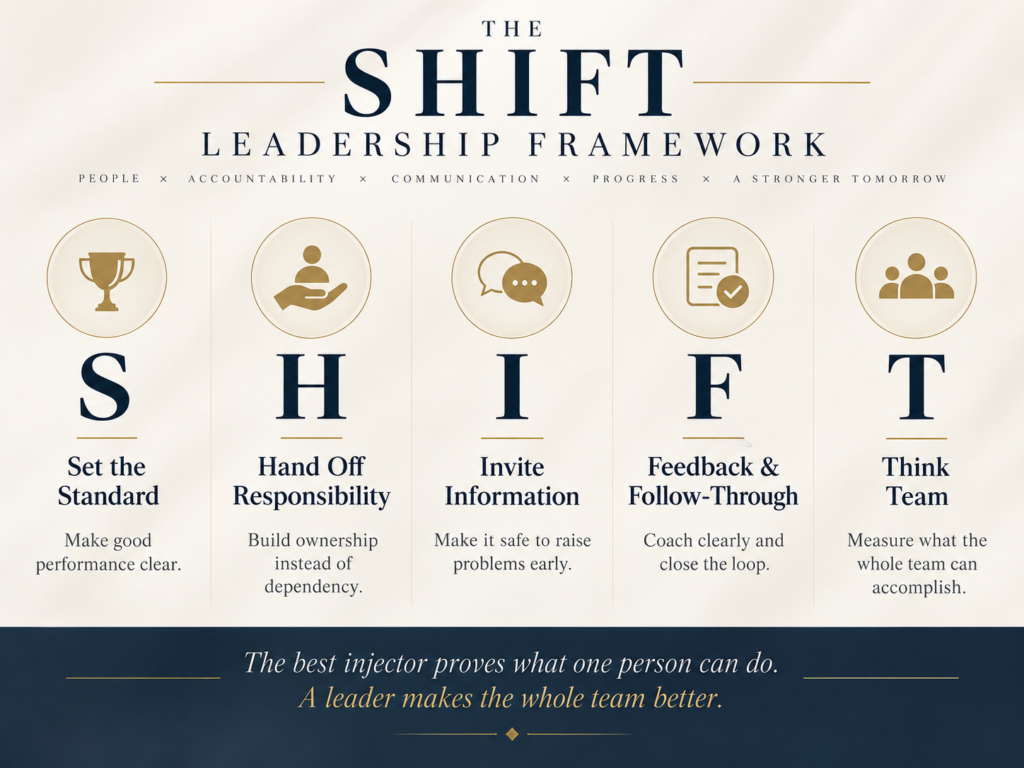
S — Set the Standard
People cannot consistently meet expectations they were never clearly given.
A leader should be able to explain:
- What good performance looks like.
- What the priorities are.
- Who owns what.
- What requires escalation.
- What the patient experience should feel like.
- How communication should happen.
- What “done” actually means.
- What behaviors are unacceptable regardless of production.
This sounds simple.
It often is not.
Practices frequently operate on invisible expectations.
The owner knows how they want the phone answered.
The lead injector knows what should happen before a consultation.
The manager knows when a patient concern should be escalated.
The front desk knows what usually happens after a cancellation.
But nobody has made the standard explicit.
Then somebody misses it.
And leadership responds:
“They should have known.”
Maybe they should have.
A stronger leader makes sure they actually do.
AHRQ’s TeamSTEPPS guidance says effective healthcare leaders should . [1]
A standard should answer four questions
What needs to happen?
Who owns it?
By when?
How will we know it was done correctly?
If those answers live only in your head, you do not have a standard.
You have a preference.
H — Hand Off Responsibility
This is where high performers struggle.
You delegate something.
Someone does it differently.
You jump back in.
Eventually everyone learns:
“Just wait. She’ll take care of it.”
Now you are exhausted and the team is underdeveloped.
Delegation does not mean abandoning responsibility.
It means deliberately transferring appropriate work while maintaining the level of oversight the situation requires.
AHRQ recommends assigning healthcare-team tasks based on factors including knowledge, experience, skill, availability, resources, and professional scope. [1]
That last part matters in medical aesthetics.
Delegation, supervision, clinical responsibilities, and scope-of-practice requirements differ by role and jurisdiction. Leadership development does not override licensing or professional requirements.
But for ordinary operational leadership, use this simple handoff:
Outcome
What result is needed?
Standard
What cannot be compromised?
Authority
What can this person decide without asking you?
Checkpoint
When will you review progress?
Escalation
What should bring the issue back to you immediately?
That creates ownership without disappearing.
Delegation without clarity feels like abandonment.
Delegation with constant interference feels like micromanagement.
Good leadership sits between the two.
I — Invite Information
One of the most dangerous things a leader can hear is:
“Nobody told me there was a problem.”
Sometimes nobody told you because nobody noticed.
Sometimes they noticed and decided telling you was not worth it.
That distinction matters.
A team performs better when people can safely say:
- “I don’t understand.”
- “I think we’re missing something.”
- “I made a mistake.”
- “I’m overloaded.”
- “This process isn’t working.”
- “I disagree.”
- “I need help.”
A 2025 systematic review of 30 healthcare-practice studies identified and concluded that strengthening it can support reliable, safe, high-quality care. [2]
That research is broader healthcare evidence—not med-spa-specific evidence.
But the leadership principle transfers well:
If the team is afraid to bring you bad news, you will eventually receive bad news late.
Invite information intentionally.
Ask:
What am I missing?
Where are patients getting confused?
What is making your job harder than it needs to be?
What problem keeps happening?
What decision are you waiting on from me?
And then pay attention to what happens when someone answers honestly.
If every difficult answer earns defensiveness, people will stop giving difficult answers.
Psychological Safety Does Not Mean No Accountability
This point matters.
A psychologically safe workplace is not one where:
“Nobody can ever be uncomfortable.”
It is not permission for poor performance.
It does not mean every decision becomes a vote.
It does not remove standards.
Strong teams need both:
Candor + Accountability
People should be able to raise a concern.
And people should still be expected to do their jobs.
The leader’s responsibility is to make those two ideas coexist.
F — Give Feedback Before Frustration Turns Into a Performance Review
Weak managers often wait too long.
Something bothers them.
Then it happens again.
And again.
Three months later, they unload every frustration in one conversation.
That is not coaching.
It is stored resentment.
AHRQ’s recommends feedback that is timely, respectful, specific, directed toward performance, and considerate of the receiver’s ability to process it. [3]
Try:
“Yesterday, three inquiries were still unanswered at closing. Our standard is that every open inquiry has a documented next action before the end of the shift. What got in the way?”
That is much more useful than:
“You need to be more responsible.”
One addresses behavior.
The other attacks identity.
Useful feedback should clarify:
What happened?
What was expected?
Why does the gap matter?
What needs to change?
What support is needed?
When will we revisit it?
And feedback should not only appear when something is wrong.
AHRQ also emphasizes reinforcing effective behavior so team members understand what should be repeated. [3]
Recognition is not fluff when it teaches the standard.
Use Briefs, Huddles, and Debriefs
Not every issue needs a two-hour meeting.
Healthcare teams already have a useful model.
AHRQ’s TeamSTEPPS framework uses:
Brief
Before the work:
What is happening? Who owns what? What should we anticipate?
Huddle
During the work:
Has something changed? Do we need to adjust?
Debrief
Afterward:
What worked? What didn’t? What do we change next time?
AHRQ’s recommends short, structured reviews focused on performance improvement, lessons learned, and what should change next time rather than assigning blame. [4]
That can translate naturally into an aesthetic practice.
A busy day goes badly?
Debrief.
A new event workflow creates confusion?
Debrief.
A patient handoff works exceptionally well?
Debrief that too.
Do not wait for an annual meeting to learn from yesterday.
Follow-Through Is Part of Feedback
A leader says:
“We’ll fix that.”
Then nothing changes.
Team members notice.
Someone raises the same issue next month.
Again:
“Yes, we need to address that.”
Still nothing.
Eventually people stop raising it.
Leadership credibility is built partly through follow-through.
If the answer is no, say no.
If you need more information, say that.
If you promise a decision Friday, make the decision Friday.
A team learns what matters by watching what leadership actually follows through on.
T — Think Team, Not Just Self
This may be the biggest identity change.
As an individual provider, you might measure yourself through:
- Patients requested.
- Schedule utilization.
- Revenue produced.
- Reviews.
- Retention.
- Clinical development.
- Personal reputation.
Those can still matter.
But leadership adds another set of questions:
- Does the team understand the priorities?
- Are roles clear?
- Are patient handoffs consistent?
- Do people raise concerns early?
- Are standards applied fairly?
- Is training actually happening?
- Are recurring problems becoming systems?
- Can other people make good decisions without you?
- Is the team improving?
Recent healthcare research supports why leadership deserves attention beyond the leader’s own productivity.
A systematic review examining leadership and found that constructive leadership styles were consistently associated with lower burnout and greater engagement, while negative leadership was associated with worse outcomes. Most included studies were cross-sectional, so these findings should be interpreted as associations rather than proof of direct causation. [5]
Another recent systematic review examining found positive relationships involving teamwork, communication, feedback, organizational learning, and safety perceptions. [6]
Again, these studies largely come from nursing and broader healthcare environments rather than medical spas.
Do not turn them into:
“Better med spa leadership increases revenue by X%.”
They do support a more defensible conclusion:
Leadership changes the environment in which the team performs.
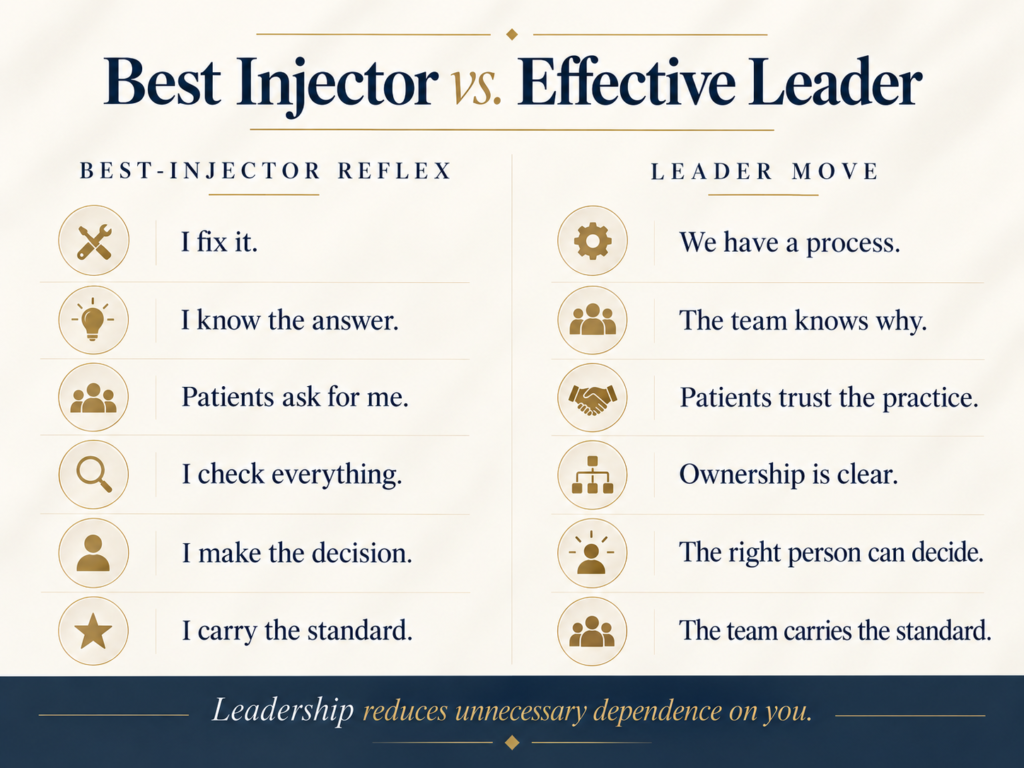
Stop Being the Practice Hero
There is a seductive version of leadership:
Everybody needs you.
You know every answer.
You solve every patient problem.
You approve everything.
You rescue every schedule.
You fix every employee mistake.
You are indispensable.
That can feel like leadership.
Often it is dependency.
The question is not:
“Can the practice survive a difficult day because I personally save it?”
The better question is:
“Have I built enough clarity, capability, and structure that the team knows what to do?”
You do not prove leadership by being needed for every decision.
Eventually, you prove it by making fewer decisions necessary.
How Do You Lead Former Coworkers?
This transition can feel awkward.
Friday:
You’re one of the team.
Monday:
You are accountable for parts of the team’s performance.
There are two common mistakes.
Mistake 1: Becoming overly authoritative
You suddenly act different because you think a leader must look powerful.
Mistake 2: Refusing to lead because you want everyone to keep liking you
You avoid difficult feedback.
Let certain people ignore standards.
Make exceptions based on friendship.
Neither works.
You do not need to become cold.
You need to become clear.
Say:
“Our relationship matters to me, but this role means I’m now responsible for making sure these expectations are consistent across the team.”
Then behave consistently.
Fairness builds more credibility than pretending nothing changed.
Accountability Is Not Micromanagement
Micromanagement says:
“Do it exactly how I would do it because I don’t trust you.”
Accountability says:
“Here is the result, the standard, your responsibility, and when we’ll review it.”
Aesthetic-industry guidance from the American Med Spa Association likewise emphasizes . [7]
Start with five things:
Expectation — What should happen?
Owner — Who is responsible?
Metric or evidence — How will we know?
Review point — When do we check?
Response — What happens if it works—or does not?
Clarity reduces the need to hover.
Leadership Does Not Require Ownership
You can lead before you own anything.
You can lead as:
- A provider.
- Lead injector.
- Senior clinician.
- Mentor.
- Trainer.
- Project lead.
- Team supervisor.
- Clinical manager.
- Office manager.
- Practice manager.
Leadership starts when you take responsibility for helping something beyond your own work succeed.
That is one reason Injector Success places leadership within the broader provider career journey—not only inside practice ownership.
You may decide you never want to own a med spa.
You can still become tremendously valuable by learning how to lead.
The 30-Day Leadership Reset
If you want to become a stronger leader, do not start with a personality test.
Start with your actual team.
Week 1 — Clarify
Identify three recurring areas where expectations are unclear.
Write the standard.
Assign ownership.
Week 2 — Listen
Ask each team member:
What is one process that creates unnecessary friction?
Listen before fixing.
Week 3 — Coach
Give one piece of timely, specific positive feedback and one useful developmental conversation where appropriate.
Do not wait for annual reviews.
Week 4 — Remove Yourself
Choose one recurring task or decision that currently depends unnecessarily on you.
Document the process.
Train the right person.
Define the escalation rules.
Step back.
Then ask:
What does the team now know how to do that previously required me?
That is measurable leadership development.
The SHIFT Leadership Check
Before calling yourself the team leader, ask:
Set the Standard
Does the team know what good looks like?
Hand Off Responsibility
Have I developed ownership—or trained everyone to wait for me?
Invite Information
Can people disagree with me or bring me problems early?
Feedback and Follow-Through
Do I coach while issues are still fixable?
Think Team
Is the team getting stronger—or am I simply getting busier?
If your answers expose a weakness, good.
That is where leadership development starts.
Frequently Asked Questions
What makes a good lead injector?
A strong lead injector combines professional credibility with clear communication, consistent standards, appropriate delegation, useful feedback, team development, and accountability.
Being clinically respected helps.
Leadership requires additional skills.
Can the best injector also be the best leader?
Absolutely.
But one does not automatically create the other.
Individual expertise and team leadership overlap, but leadership requires learning how to guide the performance of other people rather than relying only on your own ability.
Do I need to own a med spa to become a leader?
No.
Providers can demonstrate leadership through mentoring, solving problems, improving systems, communicating clearly, supporting teammates, running projects, and helping practices improve.
Ownership is only one possible career path.
How do I delegate without losing quality?
Define the expected outcome, non-negotiable standard, decision authority, review point, and situations requiring escalation.
For clinical duties, delegation and supervision must remain consistent with applicable professional roles, licensure, practice policies, and jurisdictional requirements.
How do I hold someone accountable without micromanaging?
Make the expected result explicit.
Assign responsibility.
Agree on how performance will be evaluated.
Create a reasonable checkpoint.
Then allow the person to perform instead of repeatedly taking the work back.
How should leaders give negative feedback?
Address the behavior while the issue is still relatively fresh, be specific about what occurred, explain the expected standard, listen to the employee’s perspective, agree on the next action, and follow up.
AHRQ recommends healthcare-team feedback that is timely, respectful, specific, and considerate. [3]
What is psychological safety?
Psychological safety generally describes a work environment in which people feel able to raise questions, concerns, mistakes, and differing views without inappropriate interpersonal punishment.
It is not the absence of standards or accountability.
Healthcare research has identified psychological safety as an important component of effective teamwork. [2]
Your Next Career Level May Require Less Heroics
Being known as the injector who can handle anything feels good.
But eventually there is a bigger professional question:
Can you build other people who can handle things too?
That is leadership.
Set the standard.
Give people real responsibility.
Invite information.
Coach before frustration builds.
Follow through.
Measure the team, not only yourself.
Your technical ability can make you exceptional at your job. Your leadership ability can make the entire practice better because you are there.
Explore Injector Success resources for leadership, career advancement, team development, practice management, and building toward the next stage of your career.