Marketing a new med spa should begin before opening day—but not with random posting or a giant ad budget.
Start by defining the right patient and the services you actually want to build around. Then create the infrastructure that turns attention into appointments: a useful website, an accurate Google Business Profile, an easy inquiry or booking path, reliable lead follow-up, basic tracking, and a clear message about why the practice exists.
After that, build local awareness and add marketing channels deliberately.
A useful framework is:
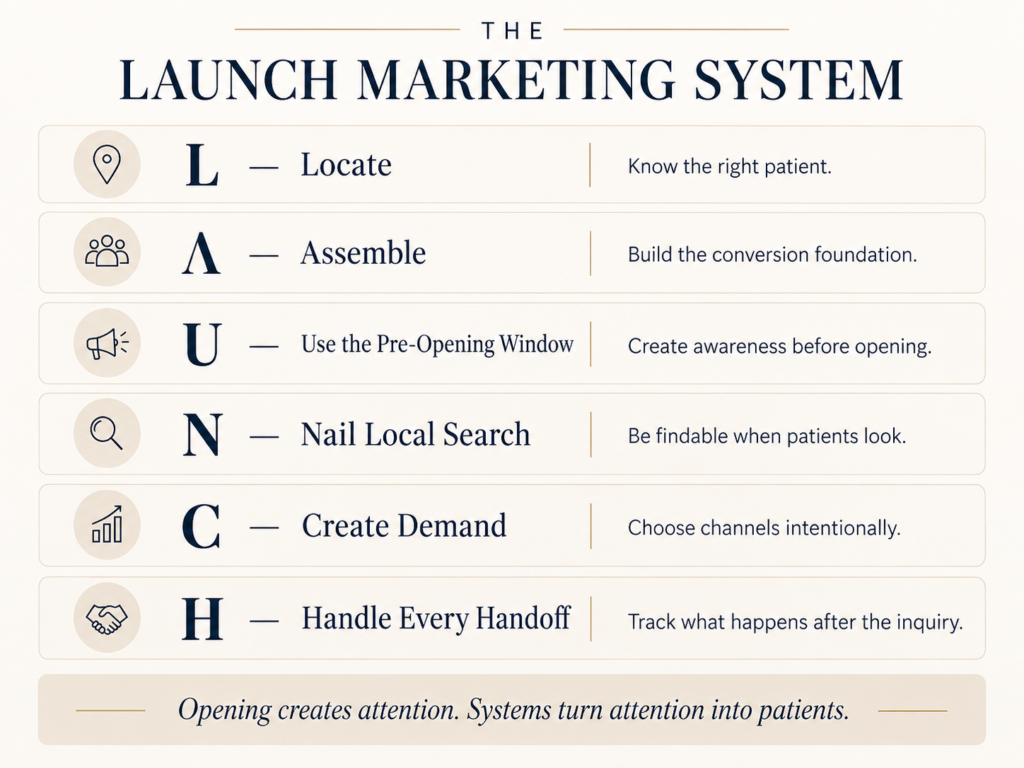
Locate → Assemble → Use the Pre-Opening Window → Nail Local Search → Create Demand → Handle Every Handoff
The LAUNCH Marketing System.
The goal is not to make opening week look busy.
It is to create a patient-acquisition system that still makes sense six months later.
L — Locate the Right Patient Before You Start Promoting
The first marketing decision is not Instagram or Google Ads.
It is:
Who is this practice actually for?
“Anyone who wants aesthetics” is not a useful answer.
The U.S. Small Business Administration recommends using to understand customers, demand, competition, market conditions, and the opportunity to differentiate a new business. [1]
For a future med spa owner, ask:
- Who lives or works within a realistic travel area?
- Which aesthetic or wellness needs are already being served?
- Which services are heavily represented locally?
- Which services do you plan to emphasize?
- What does the target patient value?
- What objections or concerns do they commonly have?
- What would make your practice meaningfully different?
- Which competitors already have strong reputations?
- Where do potential patients currently discover providers?
Do not build your positioning around:
“Luxury experience. Personalized care. Natural results.”
Those phrases can be useful, but almost every practice can say them.
Your positioning needs enough specificity that someone can understand:
Who you help.
What you are especially good at providing.
How you approach the patient experience.
Why your practice is worth considering.
If everyone is the target patient, nobody is really the target patient.
A — Assemble the Marketing Foundation Before Driving Traffic
Do not spend aggressively on attention before you have somewhere useful to send it.
At minimum, your launch foundation should make it easy for a prospective patient to answer:
- Who are you?
- Where are you?
- What services do you provide?
- Who provides them?
- Why should I trust the practice?
- What should I expect?
- How do I contact you?
- How do I book or request a consultation?
Your website does not need 100 pages before opening.
It does need to work.
A practical starting structure might include:
Home
About / Provider pages
Core service pages
Location / Contact
FAQ
Booking or consultation request
Privacy and required policies
Build around the services you actually plan to promote.
Do not create dozens of thin pages for treatments you barely offer simply because somebody gave you a keyword list.
Google’s guidance on emphasizes creating genuinely useful material for an intended audience rather than content produced mainly to manipulate rankings. [10]
The same principle should govern your med spa website.
Answer the patient’s question better. Don’t just mention the keyword more times.
U — Use the Pre-Opening Window
You do not have to wait for opening day to exist locally.
Google specifically allows eligible businesses that have not opened yet to . After the opening date is entered and the business is verified, the profile can begin appearing 90 days before the opening date. [2]
During that period, Google says businesses can publish posts, add location photos, and explain the business through the profile.
That gives a new practice a legitimate pre-opening window.
Use it.
Before opening, you can begin building:
- A local email list.
- An interest or opening-notification list.
- Social followers who genuinely fit your market.
- Relationships with complementary local businesses.
- Community awareness.
- Educational content.
- Local press or professional relationships.
- Search visibility.
- Provider recognition.
You can also document the launch itself:
- Practice buildout.
- Team introductions.
- Provider philosophy.
- Why you chose the location.
- What you want the patient experience to feel like.
- Educational FAQs.
- Opening updates.
You are not pretending to have patients you do not have.
You are giving the market a reason to know the practice exists.
One important Google-review detail
Google states that users cannot post reviews or photos to a Business Profile until the business is officially open. [2]
So do not make “get 50 Google reviews before we open” part of your launch plan.
Build relationships first.
Earn reviews from real patient experiences afterward.
N — Nail Local Search Before Trying to Become Internet Famous
A med spa is usually a geographically constrained business.
That makes local search important.
When someone searches:
med spa near me
aesthetic injector near me
laser treatment in [city]
lip filler [city]
they are not casually consuming content.
They may be actively evaluating providers.
Google says . It recommends complete and accurate Business Profile information, current hours, categories, photos, and review management. [3]
For launch, make sure the fundamentals are correct:
- Real business name.
- Correct address.
- Correct phone number.
- Accurate website.
- Accurate hours.
- Appropriate categories.
- Relevant services.
- Real photographs.
- Consistent location information.
Your website and Business Profile should reinforce each other.
Google says local-business information can come from the business itself, its official website, public web information, users, and third-party sources.
Consistency matters.
Build Reviews Honestly From the Beginning
Reviews matter for both reputation and local discovery.
Google says reviews and helpful owner responses can help businesses stand out locally, and review signals are part of prominence in local ranking. [3]
But reputation cannot become a manufactured marketing asset.
The FTC’s prohibits fake or false reviews and prohibits incentives that are conditioned on a consumer expressing a particular positive or negative sentiment. [5]
So:
Ask real patients appropriately.
Make the process simple.
Respond professionally.
Learn from negative feedback.
Do not purchase praise.
Do not manufacture reviews.
Do not say:
“Leave us five stars and get $25 off.”
A new practice needs social proof. It does not need fake proof.
C — Create Demand With Controlled Channels
A new med spa does not need to launch every channel simultaneously.
You might eventually use:
- Google Search advertising.
- Meta advertising.
- Instagram.
- Facebook.
- TikTok.
- YouTube.
- Email.
- SMS.
- Direct mail.
- Events.
- Local partnerships.
- Professional referrals.
- Community organizations.
- Local PR.
- Influencer or creator relationships.
But channels create complexity.
Start with the ones that match the patient’s intent and your ability to respond.
Use Google Ads to Capture Existing Intent
Paid search is useful when prospective patients are already searching for a service.
But do not judge Google Ads by clicks.
Google provides so advertisers can evaluate what happens after someone interacts with an ad. [4]
For a med spa, useful tracked outcomes might include:
- Consultation requests.
- Bookings.
- Calls.
- Qualified leads.
- Completed consultations.
- Treatment starts where your systems can accurately connect them.
The business question is not:
“How many clicks did we get?”
It is:
“How many appropriate patient opportunities did this channel create, and what happened to them afterward?”
Use Social Media to Build Familiarity and Trust
Social media has a different job.
It can help prospective patients understand:
- Who you are.
- How you communicate.
- What the practice believes.
- What questions patients should ask.
- What the environment feels like.
- Who the providers are.
- What appropriate expectations look like.
You do not have to turn every post into:
BOOK NOW.
Educational content can create familiarity long before someone is ready to schedule.
A new practice often has an advantage here:
The entire launch is content.
You have a story happening in real time.
Use it.
Use Local Relationships Because Trust Already Exists
A community contains existing networks of trust.
Depending on the market and applicable professional rules, useful relationships may exist with:
- Salons.
- Estheticians.
- Fitness businesses.
- Bridal professionals.
- Wellness businesses.
- Local employers.
- Professional organizations.
- Community groups.
- Appropriate healthcare providers.
- Local events.
Do not walk into every relationship asking for referrals immediately.
Create something worth referring to.
Educational collaboration, community involvement, thoughtful introductions, and professional reliability create much stronger foundations than:
“I’ll give your clients 20% off.”
Be Careful With Influencer and Creator Partnerships
If someone receives compensation, free treatment, discounts, or another benefit in exchange for promotion, disclosure obligations may apply.
The FTC’s says material relationships should be disclosed clearly and in a place viewers are likely to notice. [6]
Do not hide disclosures at the bottom of a giant hashtag block.
And do not assume a platform’s built-in disclosure tool automatically solves every requirement.
Market the Result Honestly
Medical-aesthetic marketing has another layer that ordinary retail businesses may not face.
Your content can make explicit and implied claims about outcomes.
FTC guidance on emphasizes that advertising should be truthful, not misleading, and supported before objective health-related claims are disseminated. It also advises marketers to consider the overall impression created by words, images, and other elements together. [7]
That matters with:
- Before-and-after imagery.
- Treatment-benefit claims.
- Safety claims.
- “Best” or superiority claims.
- Guaranteed-result language.
- Testimonials.
- Promotional claims.
State professional-board and medical-advertising requirements may add further rules.
Do not publish:
“Guaranteed results.”
because it sounds good on Instagram.
Market what you can support.
H — Handle Every Handoff
This is where many marketing plans stop too early.
They measure the inquiry.
Then marketing gets credit or blame.
But the actual path is longer:
Visibility → Inquiry → Response → Booking → Consultation → Appropriate Treatment → Rebooking → Retention → Referral
Marketing may create the first opportunity.
Your systems determine what happens next.
If 40 inquiries arrive and:
- Nobody responds consistently.
- Calls go unanswered.
- DMs sit overnight.
- Booking is complicated.
- Nobody follows up.
- Consultations feel rushed.
- Patients leave without a next step.
the marketing campaign may not be the problem.
That is why Injector Success’s approved keyword strategy specifically distinguishes patient acquisition from the entire revenue system.
Do not pour more traffic into a broken handoff.
Track the Patient Source From Day One
Every new practice should be able to answer:
Where did this patient come from?
Not:
“Probably Instagram.”
Track sources consistently.
At minimum, consider:
| Stage | Question to answer |
| Awareness | Where are people discovering us? |
| Inquiry | Which channels create qualified interest? |
| Response | Are we reaching those inquiries? |
| Booking | Which sources actually book? |
| Attendance | Which appointments actually show? |
| Consultation | Which sources produce appropriate treatment decisions? |
| Revenue | Which sources become collected patient revenue? |
| Rebooking | Do those patients return? |
| Referral | Do those patients introduce others? |
Google Ads itself supports conversion measurement across website actions, calls, and certain offline outcomes. [4]
Your CRM or practice-management system should complete the story beyond the click.
Follower count may be interesting.
Patient source is operationally useful.
Build an Owned Audience
Social platforms are rented attention.
Your email list is an audience you can communicate with more directly.
Before launch, consider giving interested local people a legitimate reason to opt in:
- Opening updates.
- Educational content.
- Event information.
- Practice news.
- A useful guide.
- Early scheduling announcements.
Commercial email still has rules.
The FTC’s requires commercial email to use accurate sender information and subject lines, include a valid physical postal address, provide an opt-out method, and honor opt-out requests. [9]
If you use SMS marketing, obtain practice-specific legal guidance on the applicable consent and messaging rules rather than assuming an email signup automatically authorizes promotional texts.
Be Careful With Patient Information in Marketing
If the practice is subject to HIPAA, protected health information adds another set of considerations.
HHS explains that and that many marketing uses require patient authorization, subject to specific exceptions. [8]
Do not assume:
“They are our patient, so we can market however we want.”
And do not treat a signed treatment consent as automatically equivalent to authorization for every marketing use.
Practice-specific privacy, advertising, photo/video, testimonial, and patient-communication policies should be reviewed with qualified professionals.
Your Grand Opening Is a Campaign, Not the Strategy
A grand opening can help.
It can create:
- Local awareness.
- Introductions.
- Content.
- Community relationships.
- Early consultations.
- First-patient momentum.
But the grand opening should connect to what happens afterward.
Ask:
How will attendees enter our database appropriately?
Who follows up?
What happens if they do not book that day?
How do we know which appointments came from the event?
How will the relationship continue after opening week?
Free champagne is not a marketing system.
A Practical New Med Spa Launch Timeline
60–90 Days Before Opening
Focus on foundation:
- Confirm target patient and positioning.
- Launch the essential website.
- Set up tracking.
- Establish the eligible Google Business Profile and future opening date.
- Create core service content.
- Establish social profiles.
- Start local relationship building.
- Begin collecting legitimate opt-ins.
30–60 Days Before Opening
Build visibility:
- Publish educational content.
- Introduce providers.
- Show the practice coming together.
- Develop community partnerships.
- Prepare email sequences.
- Test the inquiry and booking process.
- Consider controlled paid campaigns once the destination and follow-up process are ready.
Opening Month
Convert awareness into experience:
- Make every inquiry trackable.
- Make every booking path work.
- Train whoever answers calls and messages.
- Ask real patients for honest feedback and reviews appropriately.
- Capture first-party photography and content with appropriate permissions.
- Track patient source consistently.
First 30–90 Days
Optimize instead of guessing:
- Compare lead quality by source.
- Measure booking and show rates.
- Review consultation outcomes.
- Review marketing spend against actual patient results.
- Strengthen the channels producing good patients.
- Fix operational handoffs before simply increasing ad spend.
- Begin building rebooking, follow-up, retention, and referral systems.
That is when marketing stops being launch activity and becomes business infrastructure.
Publish Content That Answers Real Patient Questions
SEO for a new med spa should not mean writing 100 generic articles.
Start with the questions prospective patients actually need answered.
Create useful service pages and educational material around:
- What the service is.
- Who may or may not be an appropriate candidate.
- What the consultation involves.
- What expectations should be discussed.
- What patients should ask a provider.
- What alternatives may exist.
- Location-specific information.
- Provider experience and credentials where accurately represented.
Google’s 2026 explicitly recommends unique, valuable, non-commodity content and says publishers should prioritize sound SEO rather than artificial “AEO/GEO hacks.” [10]
That is the right strategy here too.
Do not create AI filler to look authoritative.
Create useful information because you actually have something useful to say.
Frequently Asked Questions
When should I start marketing a new med spa?
Start planning marketing well before opening.
Once the location, practice identity, services, opening timeline, and legal structure are sufficiently confirmed, you can begin building your website, content, local relationships, tracking, and pre-opening audience.
Google permits eligible businesses to set a future opening date, and verified profiles can appear up to 90 days before opening. [2]
What is the best marketing channel for a new med spa?
There is no single best channel for every practice.
Local search, Google Business Profile, paid search, social media, email, partnerships, events, and referrals serve different functions.
Start with the channels that match your target patient’s behavior and that you can accurately track and operationally support.
Should a new med spa run Google Ads immediately?
Potentially—but only once the landing experience and follow-up system work.
Paid search can capture existing demand, but clicks are not the goal. Google provides conversion measurement for calls and website actions, so campaigns should be judged on meaningful patient actions rather than traffic alone. [4]
Can a new med spa create a Google Business Profile before opening?
Yes, if the business meets Google’s eligibility requirements.
Google allows a future opening date up to one year ahead, and after verification the profile may appear 90 days before opening. [2]
How should a new med spa get Google reviews?
Ask real patients for honest feedback after genuine experiences.
Do not create fake reviews or condition incentives on a particular rating or sentiment. The FTC’s Consumer Reviews and Testimonials Rule specifically addresses those practices. [5]
Does a new med spa need social media?
Social media can be useful for familiarity, provider visibility, education, community engagement, and showing what the practice stands for.
But social media should support the overall patient-acquisition system rather than become the entire marketing plan.
Should a new med spa offer a grand-opening discount?
It can, but discounting should not substitute for positioning.
Make sure any offer is financially sensible, clearly explained, compliant with applicable rules, and designed to introduce appropriate patients to the practice rather than train the market to wait for discounts.
What should a new med spa measure first?
Start with:
qualified inquiries by source → contact → bookings → completed consultations → appropriate treatment starts → collected revenue → rebooking
That sequence tells you whether marketing is attracting the right people and whether the business is converting the opportunity.
Build the Marketing Before You Need It
A new practice does not need to be everywhere.
It needs to be findable.
Clear.
Credible.
Easy to contact.
Easy to book.
Prepared to respond.
And capable of measuring what happens after somebody raises their hand.
Start before opening.
Build the foundation first.
Add channels deliberately.
Track the whole patient journey.
Then improve what the numbers show you—not what the loudest marketing guru tells you to chase.
Your opening creates attention. Your systems determine whether that attention becomes a practice.
Explore Injector Success resources for med spa ownership, patient acquisition, local visibility, marketing, and building the business systems behind a successful future practice.