
AI can make an aesthetic provider faster at a surprising number of things.
It can help you brainstorm content, organize ideas, draft patient education, prepare questions, summarize source material, role-play conversations, create checklists, repurpose one idea across multiple channels, and reduce repetitive administrative work.
What it cannot do is take responsibility for the answer.
That matters because generative AI can produce an output that sounds polished, specific, and completely confident while still being wrong.
The calls this confabulation: confidently stated erroneous or false content. NIST also identifies privacy, automation bias, over-reliance, information integrity, and other risks associated with generative AI. [1]
For an injector, the useful question therefore is not:
“Can AI do this?”
It is:
“Should AI be trusted with this part of the job?”
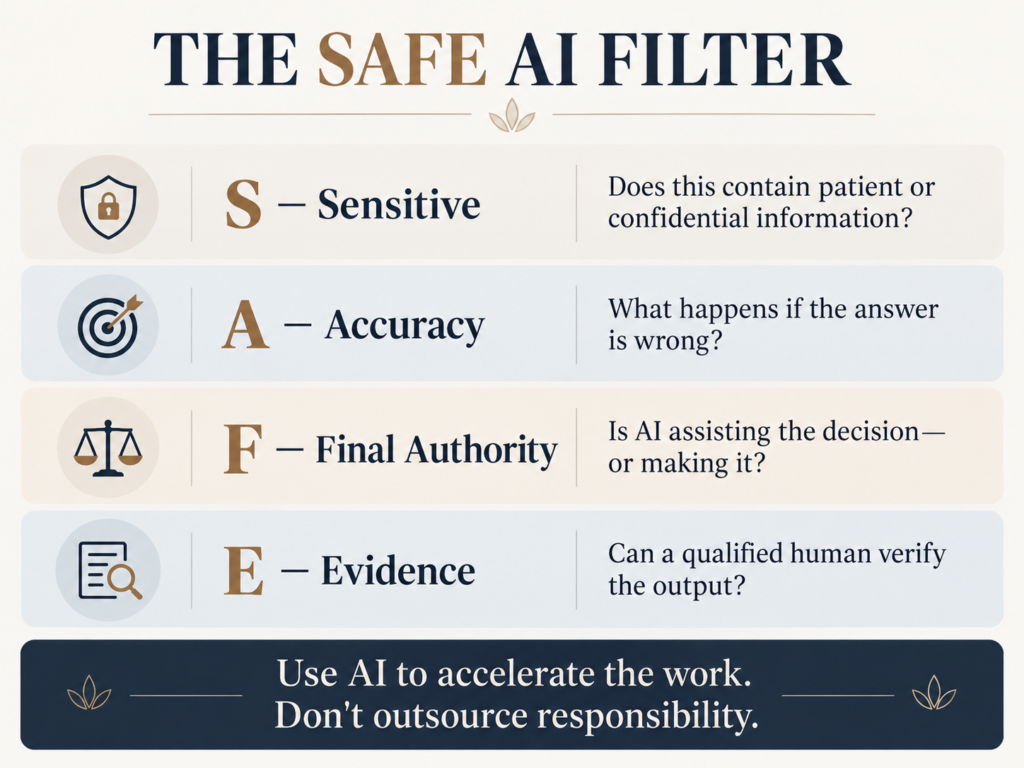
Use the SAFE AI Filter:
Sensitive → Accuracy → Final Authority → Evidence
And remember one simple rule:
Use AI to accelerate the work. Do not use it to outsource responsibility.
What Can AI Help an Injector Do?
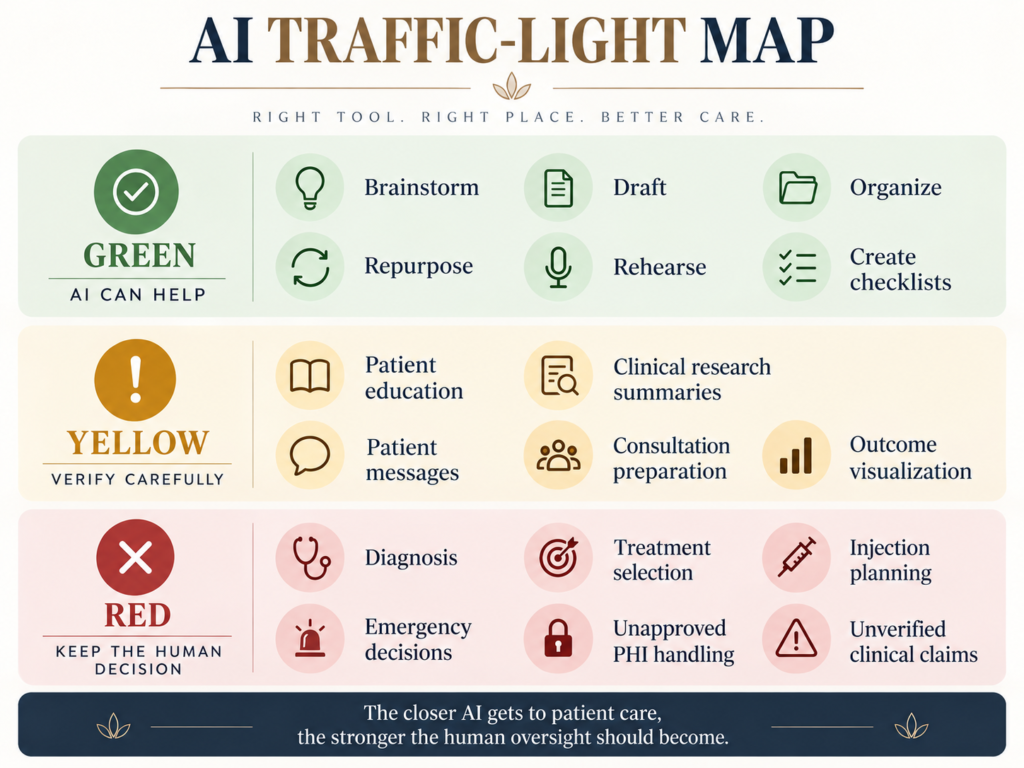
A lot—especially before a decision reaches the patient.
The World Health Organization’s identifies potential applications including administrative work, education, research, responding to patient questions, and clinical-support use cases. WHO also warns about inaccurate information, biased outputs, privacy risks, cybersecurity concerns, and automation bias. [2]
That is the right balance.
AI is not useless because it has risks.
It is useful because you understand the risks well enough to use it appropriately.
GREEN: Use AI for Low-Risk Preparation and Productivity
1. Brainstorm Content Faster
AI is excellent at getting you past the blank page.
Try asking it for:
- Ten patient questions about a topic.
- Five angles for a LinkedIn post.
- A 30-day content outline.
- Hooks for a short video.
- FAQ ideas.
- Ways to repurpose one article.
- Interview questions.
- Newsletter subject ideas.
The advantage is not that AI automatically knows your brand better than you do.
It doesn’t.
The advantage is speed.
You choose the good ideas and throw away the generic ones.
2. Turn One Idea Into Multiple Pieces of Content
Suppose you record a two-minute explanation about why a consultation sometimes ends with no treatment.
AI can help turn that idea into:
- A LinkedIn post.
- An Instagram caption.
- A short email.
- FAQ copy.
- A video outline.
- An article section.
- A carousel structure.
- A list of follow-up questions.
That is useful leverage.
Google itself says . At the same time, Google warns that mass-producing pages without adding meaningful value can run into its scaled-content spam policies. [11]
Translation:
Use AI to expand your thinking—not to flood the internet with filler.
3. Practice Conversations
AI can be a useful rehearsal partner.
You can ask it to play:
- A nervous first-time patient.
- A patient worried about price.
- Someone with unrealistic expectations.
- A prospective employer interviewing you.
- A team member resisting feedback.
- A local business owner you want to approach.
You can then practice how you would respond.
This works because the output is not making the real decision.
It is helping you prepare for the real conversation.
4. Build Checklists, Templates, and First Drafts
AI can help organize repetitive work.
For example:
- Content checklists.
- Meeting agendas.
- Nonclinical SOP outlines.
- Event-planning checklists.
- Lead-follow-up templates.
- Interview scorecards.
- Training outlines.
- Professional biography drafts.
- Career-planning worksheets.
Do not confuse:
“AI made the first draft.”
with:
“The draft is now our approved policy.”
Those are two different steps.
YELLOW: Use AI, but Require Human Verification
This is where the stakes begin to rise.
Can AI Help Write Patient Education?
Yes.
But draft is the important word.
AI can help turn complicated language into a simpler explanation, organize an FAQ, suggest questions patients may have, or restructure material you already know is accurate.
What you should not do is ask a general chatbot a medical question and paste the answer directly onto your website or hand it to a patient without review.
A 2024 study evaluating ChatGPT and Google Bard as found that the systems could produce useful responses, but the generated references were a major weakness. Of 108 references generated when citations were requested, only 41 were legitimate, and just 20 accurately represented information from the purported reference. [8]
Those systems and versions are not today’s systems, so the numbers should not be treated as a 2026 chatbot benchmark.
The enduring lesson is more important:
A citation-looking object is not necessarily a real source.
Open the source.
Read it.
Make sure it says what the AI claims it says.
Can AI Help Prepare for Patient Questions?
Yes.
A useful prompt might be:
“Give me 20 questions a first-time aesthetic patient may ask about this topic. Do not answer them.”
Now you have a preparation list.
Then use appropriate authoritative sources, your training, current guidance, practice protocols, and professional judgment to prepare the actual answers.
That is very different from:
“Tell me exactly what to tell this patient about their medical situation.”
Preparation is a good AI use.
Delegating the individualized clinical answer is not.
Can AI Summarize Research?
Yes—with verification.
You can use AI to:
- Explain terminology.
- Compare study designs.
- Turn technical text into plain English.
- Extract questions you should investigate.
- Organize several papers by theme.
- Identify contradictions for further review.
But never trust a generated study title, DOI, statistic, quotation, or clinical recommendation simply because it looks scholarly.
NIST specifically warns that generative systems can produce not only inaccurate conclusions but also confabulated citations and reasoning that make an incorrect answer look more convincing. [1]
AI can help you research. It cannot be your evidence.
The evidence is the source.
Can AI Help With Clinical Aesthetic Decisions?
This is where the answer needs to become much more cautious.
AI research in aesthetics is real.
A 2026 review of identified published work involving patient education, diagnosis, clinical decision-making, outcome prediction, outcome assessment, practice management, and other applications. [6]
A 2026 likewise found applications across image analysis, treatment planning, outcome assessment, and patient communication. [7]
But:
Researching AI-assisted clinical tools is not the same as approving a general chatbot to practice medicine.
RED: Do Not Let a General AI Tool Become the Injector
AI Should Not Independently Decide an Injection Plan
This one has already been studied.
A 2025 observational study evaluated in 40 patients receiving botulinum toxin or hyaluronic-acid treatment. The authors concluded that safety limitations remained and precluded unsupervised clinical use. [9]
That does not mean no validated AI-assisted tool will ever support injection planning.
It means:
Do not confuse a chatbot that can generate a plan with a system proven safe enough to make the decision.
AI Should Not Replace Patient Assessment
An AI system does not take professional responsibility for:
- History.
- Examination.
- Contraindications.
- Patient suitability.
- Expectations.
- Consent.
- Risk assessment.
- Scope-of-practice requirements.
- Complication management.
- Follow-up.
Those belong to appropriately qualified humans operating within applicable professional and jurisdictional requirements.
If software begins influencing diagnosis or treatment recommendations, the regulatory picture can also change.
The FDA’s current explains that certain decision-support functions can fall outside the medical-device definition when specific statutory criteria are met, while other software functions remain subject to FDA digital-health policies. [5]
The practical takeaway is not:
“All AI clinical software is regulated.”
It is:
Do not assume an AI tool is clinically validated or appropriately regulated simply because it gives medical-sounding answers.
Do Not Feed Patient Information Into AI Without Understanding the Environment
This deserves its own rule:
Do not paste patient information into a random AI tool because it is convenient.
If your practice is a HIPAA covered entity or business associate and an outside cloud service creates, receives, maintains, or transmits electronic protected health information on your behalf, HHS’s explains that the service provider generally becomes a business associate and a HIPAA-compliant business associate agreement is required. [3]
That means you need to know things like:
- Is this tool approved by the practice?
- What data is being transmitted?
- How is it stored?
- What does the vendor do with it?
- Is a BAA required?
- Is one actually in place?
- What do the privacy and security settings mean?
- What does your organization permit?
And do not assume:
“I’ll just remove the patient’s name.”
automatically solves the problem.
HHS’s recognizes two formal approaches for de-identifying protected health information: Expert Determination and Safe Harbor. HHS also warns that identifiers can exist inside free-text narratives, not just obvious database fields. [4]
De-identification is a compliance process—not a vibe.
Be Extremely Careful With Patient Photos
Photos can be sensitive even when the patient’s name is nowhere in the prompt.
A face is identifying.
A distinctive tattoo can be identifying.
Metadata or surrounding information can also matter.
Do not upload clinical photography into an AI product until you understand:
- Practice policy.
- Patient authorization where applicable.
- Vendor terms.
- Data retention.
- Training-data policies.
- Security.
- Applicable privacy rules.
- Whether the tool is actually approved for that purpose.
The fact that software accepts the upload does not mean you are authorized to provide it.
AI-Generated Results Are Not Treatment Promises
AI visualization deserves extra caution in aesthetics because patients may naturally interpret an image as a prediction.
A systematic review of specifically warned that AI-generated preoperative simulations may show outcomes patients like but that may not actually be achievable. [10]
So if an AI tool creates an idealized future face, ask:
Is this education?
Is this visualization?
Or will the patient reasonably interpret it as “this is what I’m going to look like”?
Those are not the same thing.
Never let a beautiful simulation become an accidental guarantee.
AI Should Not Become Your Fake Expertise
There is another career risk.
AI makes it easy to sound knowledgeable about something you have not actually learned.
You can ask for:
“A sophisticated explanation of facial anatomy.”
and receive one in seconds.
You can post it under your own name.
That does not make you an expert on the topic.
Do not use AI to manufacture authority you have not earned.
Use it to help:
- Organize what you know.
- Identify what you need to learn.
- Improve communication.
- Explore questions.
- Prepare better.
Your reputation becomes dangerous when the public version of your expertise moves ahead of your actual competence.
AI Cannot Replace Human Connection
The more technology enters the practice, the more valuable good human communication may become.
AI can draft:
“I understand why that would be frustrating.”
But AI does not carry professional responsibility for the conversation.
It does not see the patient’s hesitation unless the system is specifically designed and validated to detect something.
It does not own the relationship.
It does not repair trust after an unexpected outcome.
It does not know what a patient meant when their words and body language do not match.
WHO’s generative-AI guidance explicitly raises concerns about over-reliance and improperly delegating difficult health decisions to AI systems. [2]
Efficiency should create more room for human connection—not eliminate it.
The SAFE AI Filter
Before using an AI tool, run the task through four questions.
S — Sensitive
Does the prompt contain:
- Patient information?
- Patient photos?
- Employee information?
- Confidential business data?
- Credentials or access information?
- Proprietary documents?
If yes, stop and confirm the approved environment first.
A — Accuracy
What happens if the answer is wrong?
If the consequence is:
“This Instagram hook is mediocre.”
the risk is low.
If the consequence is:
“The patient receives the wrong clinical recommendation.”
the risk is completely different.
Match your verification effort to the consequence of being wrong.
F — Final Authority
Is AI helping you:
brainstorm → draft → organize → rehearse → summarize
or is it being allowed to:
diagnose → decide → prescribe → approve → clear → treat
Those are different roles.
Keep the human professional in the decision.
E — Evidence
Can you verify:
- The source?
- The guideline?
- The policy?
- The study?
- The legal requirement?
- The product information?
- The clinical claim?
If not:
Do not promote uncertainty into fact just because AI wrote it confidently.
A Practical AI Policy for an Aesthetic Provider
You do not need a 40-page corporate AI manual to begin using AI more responsibly.
Start with five rules:
1. Know which tools are approved.
Especially for anything involving patient or confidential information.
2. Separate productivity AI from clinical AI.
Do not treat every product with the word “AI” as though it belongs in the same risk category.
3. Verify patient-facing information.
Anything educational, medical, legal, financial, or professional should be checked before publication or delivery.
4. Keep qualified humans accountable.
AI may support the workflow.
It should not become the excuse:
“That’s what the computer recommended.”
5. Review the policy as technology changes.
The AI tool you evaluate today may have different features, terms, security settings, or model behavior six months from now.
Frequently Asked Questions
How can injectors use AI safely?
Use AI primarily for brainstorming, drafting, organization, preparation, content repurposing, role-play, research assistance, and other low-risk tasks.
Increase human review as the output becomes patient-facing or clinically relevant.
Do not use a general AI chatbot as an autonomous clinical decision-maker.
Can an injector use ChatGPT for patient education?
It can help create a draft.
The final patient education should be reviewed for clinical accuracy, completeness, appropriate scope, readability, and consistency with current authoritative sources and practice policy.
Research on aesthetic patient-education chatbots has found useful outputs but also problems with references and reliability. [8]
Can an injector put patient information into an AI tool?
Do not assume that is appropriate.
If HIPAA applies to the practice and the AI/cloud provider creates, receives, maintains, or transmits ePHI, HHS guidance may require a business associate agreement and appropriate safeguards. [3]
Other privacy, employer, contractual, professional, or state requirements may also apply.
Can AI create an injection treatment plan?
It technically can generate one.
That does not mean you should rely on it.
A 2025 study evaluating AI-generated facial injection planning concluded that safety limitations precluded unsupervised clinical use. [9]
Can AI analyze a patient’s face?
Specialized AI-based facial-analysis and imaging technologies exist and continue to be researched in aesthetic medicine.
Their usefulness depends on the specific product, intended use, validation, patient population, regulatory status, data handling, and how the output is incorporated into professional judgment. [6][7]
Do not treat every consumer image model as a clinical facial-analysis system.
Will AI replace aesthetic injectors?
Current evidence does not justify making that prediction.
AI is increasingly being studied for education, imaging, analysis, planning, administrative work, and decision support, but aesthetic care still requires professional judgment, patient communication, accountability, appropriate clinical assessment, and human responsibility. [6][7]
The more useful career question is:
Which providers will learn to use AI well without allowing it to weaken their judgment?
AI Is a Force Multiplier—Which Means It Multiplies the User Too
Give AI to a thoughtful provider and it can help them research faster, prepare better, communicate more clearly, and get repetitive work out of the way.
Give it to someone who never checks a source, ignores privacy, and assumes confidence equals accuracy?
It can help them make mistakes faster too.
That is the part of AI adoption nobody should skip.
Learn the tool.
Know the limitation.
Protect the patient.
Verify the output.
Keep the professional accountable.
The future probably isn’t AI versus injectors. It is providers learning which parts of the job technology should accelerate—and which parts should remain unmistakably human.
Explore Injector Success resources for practical AI use, patient communication, career development, practice management, and building the professional skills that sit beside clinical expertise.