
Becoming a sought-after injector takes more than technical competence, certifications, or a large social media following. Patients come back to providers they trust. They recommend providers who listen, communicate clearly, create a strong experience, and consistently make them feel confident in their care.
Practices notice those same qualities.
A sought-after injector builds a reputation that creates demand over time: patients request them, return to them, refer others, and trust their recommendations. At the same time, they become increasingly valuable to the practice around them.
Technical competence may open the door. Reputation, trust, consistency, and value are what make people ask for you by name.
1. Build Trust Before You Try to Build Popularity
Visibility can help people discover you. It cannot make them trust you.
Trust is built through hundreds of smaller moments: how you listen, explain something, manage expectations, answer questions, follow through, and handle situations when the answer is not what a patient hoped to hear.
Research across healthcare settings consistently connects clear communication, empathy, active listening, partnership, and shared decision-making with stronger patient trust. [1]
That matters in aesthetics because the relationship is personal. Patients are making decisions involving their appearance, confidence, money, and health.
Being trustworthy means:
- Listen before recommending.
- Explain options in language the patient understands.
- Be honest about limitations and realistic expectations.
- Never pressure someone into an inappropriate treatment.
- Be consistent from one appointment to the next.
- Do what you said you would do.
A personal brand can make you visible.
Your behavior determines what that brand eventually means.
2. Learn to Communicate as Well as You Treat
Clinical knowledge and communication ability are different skills.
A provider may understand exactly what they would recommend but struggle to communicate that recommendation in a way that helps the patient understand the reasoning behind it.
That creates hesitation.
Strong consultations are not about becoming a better salesperson. They are about becoming a better communicator.
A productive consultation should help the provider understand:
- What the patient wants to accomplish.
- Why it matters to them.
- What concerns or questions they have.
- What expectations are realistic.
- What options may be appropriate.
- What the logical next step is.
Research into shared decision-making shows that communication practices can either encourage patients to participate in decisions or make that participation more difficult. [2]
The goal is not to push the patient toward a yes.
The goal is clarity.
A practice may track its med spa consultation conversion rate, but conversion alone does not tell the entire story. An appropriate decision not to treat can be the right outcome. Patient trust comes first.
3. Create a Patient Experience People Remember
Patients do not experience your technical ability in isolation.
They experience the appointment.
Were you prepared?
Did you remember why they came in?
Did you listen without rushing?
Did you explain what would happen next?
Did the experience feel organized?
Did someone follow up?
Small details become part of your reputation because patients usually cannot evaluate every technical aspect of the care they receive. They can absolutely evaluate how the experience made them feel.
That means the patient experience starts before the treatment and continues after it.
Think beyond the procedure itself:
Before: Be prepared and understand why the patient is visiting.
During: Listen, educate, communicate clearly, and set appropriate expectations.
After: Explain the next step, provide appropriate follow-up, and make it easy for the patient to know what comes next.
Great patient experiences are rarely accidental.
They are repeatable.
4. Give Patients a Reason to Return
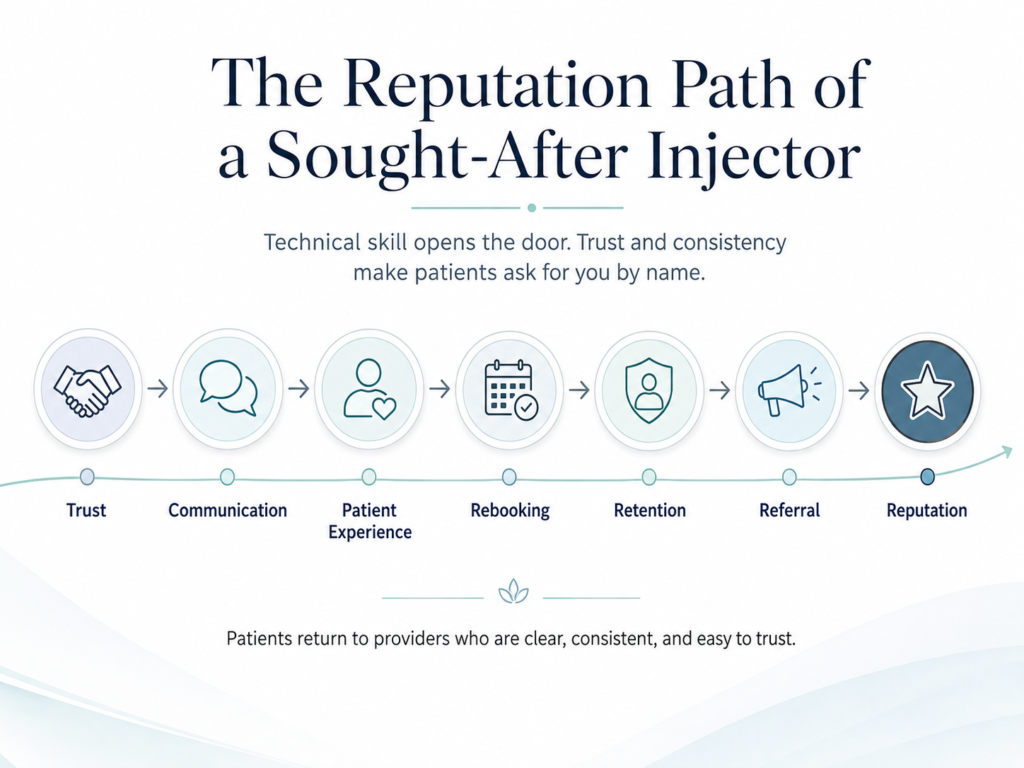
Getting a new patient is one achievement.
Becoming the provider they want to return to is another.
Strong med spa patient retention begins with trust and an experience worth repeating. It is then supported by consistent communication and appropriate follow-up.
Industry guidance from the American Med Spa Association has emphasized patient retention as an important practice-growth opportunity and connects it with genuine patient relationships, consultations, education, personalized treatment planning, and follow-up. [3]
For an injector, that means you should understand the business impact of:
- Med spa rebooking rate
- Repeat visits
- Patient referrals
- Appropriate follow-up
- Med spa patient lifetime value
These are not reasons to recommend unnecessary treatment.
They are reasons to create a patient experience strong enough that appropriate patients want to continue the relationship.
Here is the distinction:
Retention should be earned, not engineered.
The provider earns it through trust, communication, appropriate care, consistency, and follow-through. The practice’s systems simply make sure that relationship does not disappear because everyone forgot the next step.
5. Become Easy to Recommend
Patients rarely refer someone because a provider asked them to memorize a referral script.
They refer because they had an experience worth talking about.
A patient might tell a friend:
“She really listened.”
“He explained everything without making me feel pressured.”
“I felt comfortable asking questions.”
“She actually remembered me.”
“I trust what he recommends.”
Those statements are reputation.
A med spa referral program can support referrals, but it cannot manufacture genuine advocacy. If patients do not already feel confident recommending you, an incentive will not solve the underlying problem.
Focus first on becoming recommendable.
Then make referrals easy.
That same principle applies professionally. Build good relationships with coworkers, employers, educators, other providers, and people in your community.
Your reputation travels through rooms you are not in.
Make sure it represents you well.
6. Build Professional Visibility Without Becoming Performative
You do not need to become an influencer to become sought-after.
You do need to make it possible for the right people to understand who you are, what you care about, and why they should trust you.
Professional visibility can come from:
- Educational social content
- Thoughtful patient education
- Community events
- Networking
- Speaking opportunities
- Professional organizations
- Relationships with complementary local professionals
- Useful comments and conversations online
- Consistently sharing what you are learning
Social media is one tool.
Follower count is not the goal.
A provider with a smaller but highly relevant audience and a strong local reputation may be building something far more valuable than someone collecting attention that never becomes trust.
Do not ask only, “How do I get more followers?”
Ask, “What do I want people to know me for?”
That is a much better career question.
7. Become More Valuable to the Practice
The most sought-after providers do more than perform appointments.
They make the organization around them stronger.
They communicate well with the front desk. They follow systems. They protect the patient experience. They solve problems instead of simply pointing them out. They understand that retention, referrals, reputation, and operational consistency affect everyone.
You do not need to own the practice to think like someone responsible for its success.
Learn the basic numbers connected to your work.
Understand your rebooking patterns. Pay attention to patient retention. Know whether your consultations are creating clarity. Notice where communication breaks down.
Then help improve it.
Leadership often starts long before somebody gives you a leadership title.
Become the person the practice trusts with more responsibility because you consistently create value.
8. Build Your Reputation Over the Next 90 Days
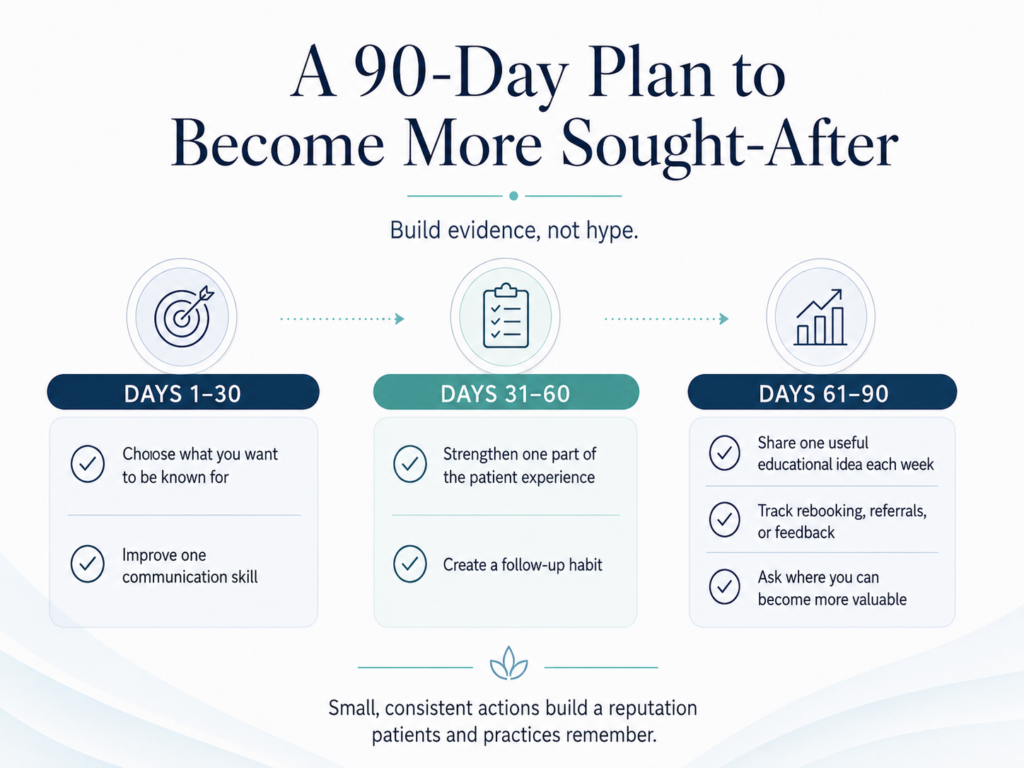
You do not need to reinvent your career this week.
Build evidence.
For the next 90 days:
- Decide what you want to be known for.
Choose two or three qualities you want patients and colleagues to associate with your name. - Improve one communication skill.
It might be listening, explaining recommendations, discussing expectations, or helping patients understand their options. - Improve one part of the patient experience.
Find a small friction point you can control and make it better. - Create a follow-up habit.
Work within your practice’s approved systems to make appropriate follow-up more consistent. - Share one useful educational idea every week.
You do not need daily content. Start by being consistently useful. - Track evidence of progress.
Look at relevant measures such as rebooking, referrals, patient feedback, repeat visits, or consultation outcomes. - Ask where you can become more valuable.
Talk with a manager, mentor, or trusted colleague. Ask what would make the biggest difference to your patients and your practice.
Do that for 90 days before chasing another complicated strategy.
Reputation compounds.
But only if you give it something worth compounding.
Frequently Asked Questions
Do I need a large social media following to become a sought-after injector?
No. Social media can increase visibility, but visibility and professional demand are not the same thing. Patient trust, reputation, communication, relationships, repeat visits, referrals, and the value you create for your practice matter more than follower count alone.
Can a newer injector become sought-after without years of experience?
A newer provider cannot shortcut the experience required to develop clinical competence. But you can begin building a strong professional reputation immediately through reliability, communication, continued learning, professionalism, patient-centered behavior, and a willingness to contribute to the practice.
Do not pretend to have experience you do not have.
Become known for how seriously you approach becoming better.
How can I tell whether patients and my practice see me as valuable?
Look for evidence rather than compliments alone.
Are appropriate patients requesting you? Are they returning? Are they referring others? Is your rebooking improving? Do colleagues trust you? Are managers giving you more responsibility? Are you contributing ideas and solving problems?
No single metric proves that you are sought-after.
The pattern tells the story.
Become the Injector People Ask For
Becoming a sought-after injector is not one marketing campaign, one certification, or one viral post.
It happens when patients consistently experience competence, trust, communication, professionalism, and genuine care—and when the practice consistently experiences you as someone who creates value.
Build the reputation first.
Visibility can amplify it later.
You do not become sought-after by telling people you are exceptional. You become sought-after by giving patients and practices enough consistent evidence to reach that conclusion themselves.
Explore Injector Success resources for building your reputation, patient following, and long-term career.
External Sources Used
[1] Tan Z, Sun Z, Lin Y. “How Physician Communication Style Shapes Patient Trust: A Systematic Review.” Health Communication, 2026. PubMed.
Research reviewed 13 studies and found that clear information delivery, empathy, active listening, shared decision-making, and supportive communication were generally associated with greater patient trust.
PubMed — How Physician Communication Style Shapes Patient Trust
[2] Land V, Parry R, Seymour J. “Communication practices that encourage and constrain shared decision making in health-care encounters: Systematic review of conversation analytic research.” Health Expectations, 2017.
The review examined 28 publications and identified communication practices that can encourage or constrain patient participation in healthcare decisions.
PubMed — Communication Practices and Shared Decision Making
[3] American Med Spa Association. “The Power of Patient Retention.”
Industry guidance discusses patient retention in medical aesthetics and the roles of genuine