
Ethical selling in aesthetics means helping an appropriate patient make an informed, voluntary decision—not manipulating them into buying more.
You can confidently recommend.
You can discuss value.
You can talk about price.
You can explain why one option may make more sense than another.
You can ask whether the patient wants to move forward.
What changes everything is how you do it.
A strong aesthetic consultation starts with the patient’s goal, uses clear education and professional judgment, explains relevant options and expectations honestly, and leaves enough room for the patient to make a genuine decision.
Sometimes that decision is yes.
Sometimes it is not yet.
Sometimes it is a different plan.
And sometimes the right answer is no treatment at all.
That is not failed selling.
That is ethical professional guidance.
Research involving cosmetic injectable patients supports why this matters. In CIPEES Part 3, qualifications and training ranked first among measured contributors to practitioner trust, followed by reputation and time spent with the patient. [1]
A 2026 systematic review likewise found that clear information, empathy, active listening, partnership, and shared decision-making were generally associated with stronger patient trust. [2]
If you want to become more confident discussing treatment plans without becoming “salesy,” use this framework:
Clarify → Assess → Recommend → Explain → Support
The CARES Framework.
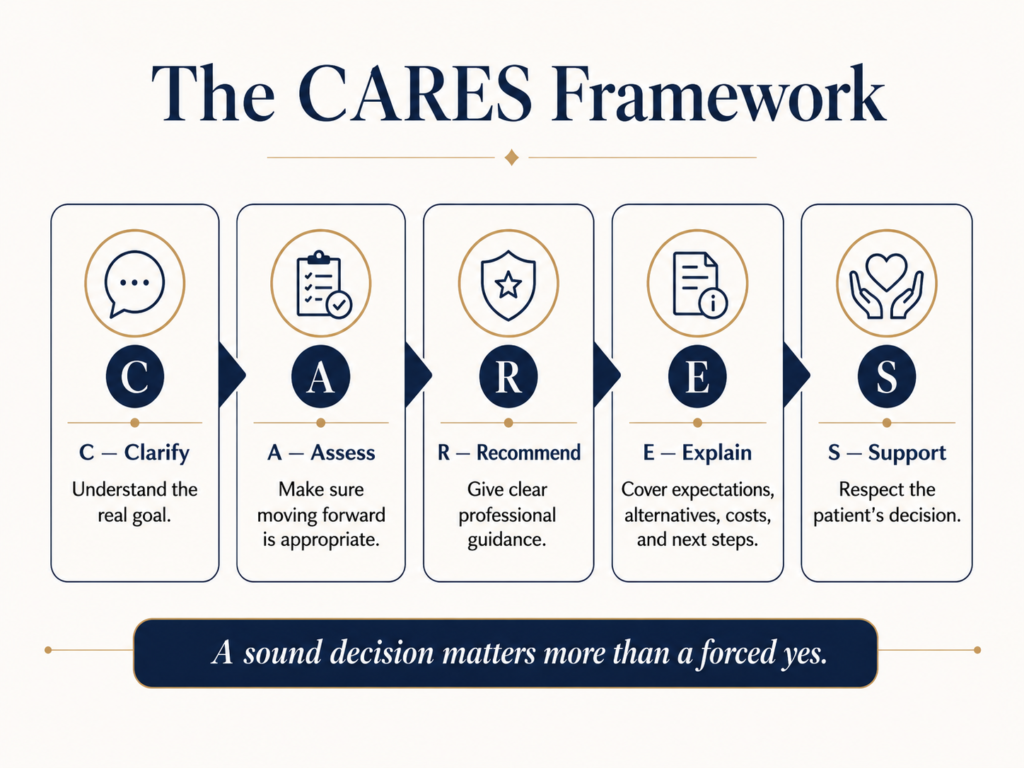
C — Clarify the Goal Before You Try to Solve It
A patient who says:
“I want filler.”
has expressed a treatment request.
They have not necessarily explained the goal behind it.
Before recommending anything, understand:
- What bothers them?
- What are they hoping will change?
- Why are they considering it now?
- What does a good result mean to them?
- What would feel like too much?
- What concerns do they have?
- What previous experiences are influencing them?
- What constraints matter—timing, budget, downtime, uncertainty?
This matters because aesthetic patients do not all want the same thing.
CIPEES research on patient mindset found meaningful variation in patient goals, attitudes, and preferred outcomes and emphasized understanding the individual rather than treating every aesthetic patient as one archetype. [3]
So do not start with:
“Here’s what I can sell.”
Start with:
“What are we actually trying to accomplish?”
The quality of the recommendation depends on the quality of the discovery.
A — Assess Whether Moving Forward Is Appropriate
Ethical selling requires a provider to be comfortable with one word:
No.
Or sometimes:
Not yet.
Professional judgment should not disappear because the service is elective or cash-pay.
A 2026 review on patients who may be unsuitable for aesthetic dermatologic procedures specifically discusses situations in which refusing treatment may be appropriate because of medical, psychological, ethical, or expectation-related concerns. The review emphasizes patient selection, clear communication, autonomy, and the professional obligation to avoid harm. [4]
The exact assessment process depends on professional role, procedure, jurisdiction, training, practice protocols, and the individual patient.
This article is not a substitute for those requirements.
The business principle, however, is straightforward:
A revenue target should never make an inappropriate treatment look appropriate.
That means conversion rate cannot be the only measure of a successful consultation.
An appropriate decision not to proceed may be the best result.
R — Recommend With a Reason
There is a difference between pressure and professional confidence.
Pressure sounds like:
“You really need all three of these.”
Professional guidance sounds more like:
“Based on the goal you described, here’s where I would start—and here’s why.”
Patients came to a professional partly because they want expertise.
Do not make them choose from a giant menu without guidance.
A strong recommendation should answer three questions:
What are you recommending?
Be clear.
Why does it connect to the patient’s stated goal?
Bring the conversation back to what they told you.
Why are you not recommending the other possibilities?
When useful, explain priorities and alternatives.
AHRQ defines shared decision-making as a collaborative process in which patients and clinicians combine evidence, professional knowledge, and the patient’s goals, preferences, and circumstances to determine the best path forward. [5]
Shared decision-making does not mean the provider stops having an opinion.
It means the recommendation and the patient’s preferences meet in the same conversation.
Patients deserve autonomy. They also deserve useful guidance.
E — Explain the Entire Decision, Not Just the Attractive Part
If you explain only why a patient might want the treatment, you are advertising.
If you help them understand the full decision, you are educating.
Depending on the situation and your role, that may include relevant discussion of:
- What the recommendation is intended to accomplish.
- What it cannot accomplish.
- Realistic expectations.
- Relevant risks or limitations.
- Alternatives.
- Whether doing nothing is an option.
- Timing.
- Follow-up.
- Total cost.
- Likely future maintenance or additional stages when applicable.
- What happens next.
For physicians specifically, the AMA Code of Medical Ethics says informed consent involves presenting relevant information about the recommended intervention, expected benefits, burdens and risks, alternatives, and the option of forgoing treatment so that the patient can make an independent and voluntary decision. [6]
That is physician-specific guidance, not a universal scope-of-practice rule for every aesthetic professional.
But the broader communication standard is useful:
A patient should understand what they are agreeing to—not simply be excited enough to agree.
A separate 2026 review of ethics in invasive cosmetic dermatology similarly emphasizes competence, transparency, informed consent, honest advertising, and patient safety over procedural expansion. [7]
Be Straight About Price
Providers often become uncomfortable the moment money enters the conversation.
That discomfort can create its own problem.
They rush.
Apologize.
Defend the price.
Avoid answering directly.
Or start piling on value statements because silence feels awkward.
You usually do not need any of that.
Explain the price clearly.
Explain what is included.
If there may be additional phases, maintenance, or other foreseeable costs relevant to the plan, explain those appropriately too.
Then stop talking long enough for the patient to process it.
Price is information.
You do not have to behave as though mentioning it has suddenly transformed you from a provider into a salesperson.
S — Support the Decision Instead of Forcing It
A voluntary decision requires room for the patient to make one.
If the only acceptable answer in your mind is yes, the consultation is already drifting toward pressure.
A patient may say:
“I need to think about it.”
Do not automatically treat that as an objection you need to defeat.
Find out whether anything remains unclear.
Try:
“Of course. Is there anything about the plan you still feel uncertain about?”
Maybe they need clarification.
Maybe the price is uncomfortable.
Maybe they are nervous.
Maybe timing is bad.
Maybe they want to discuss it with someone.
Maybe they simply do not want treatment.
Those are different situations.
A hesitation is information before it is an objection.
Shared decision-making explicitly recognizes that patient values, circumstances, and preferences belong in the healthcare decision. [5]
Your job is to make the decision understandable.
Not inevitable.
Ethical Selling Does Not Mean Never Asking for the Appointment
Avoiding pressure does not mean becoming passive.
If an appropriate patient understands the recommendation, has had their questions answered, and appears ready to proceed, it is completely reasonable to clarify the next step.
For example:
“Would you like to move forward with that plan?”
That is a question.
Not coercion.
Or:
“Would you like us to look at scheduling options?”
Again, a clear next action.
There is nothing inherently more ethical about making the patient guess how to proceed.
Clarity is not pressure.
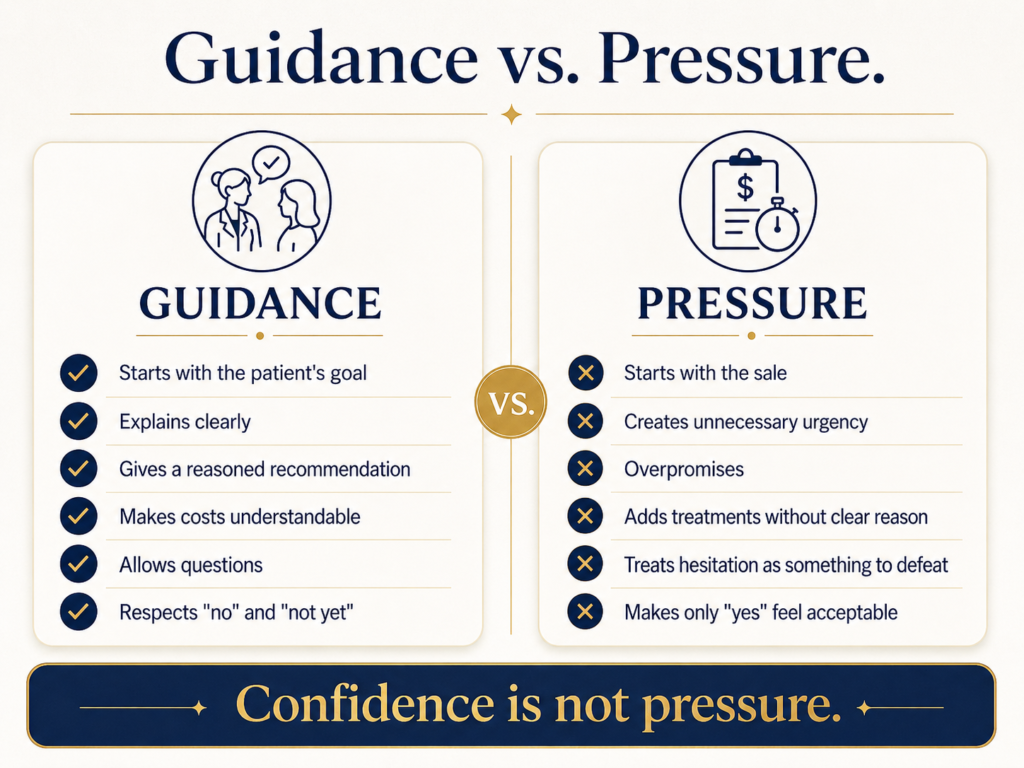
Stop Trying to “Overcome” Every Objection
The phrase objection handling can create the wrong mindset if providers interpret it as:
Patient says no → provider finds a way around the no.
Instead, treat objections as diagnostic information.
If the patient says:
“That’s more than I expected.”
Do not immediately justify the price.
Ask what they had expected.
If they say:
“I’m nervous.”
Do not instantly push reassurance.
Find out what worries them.
If they say:
“I need to think.”
Do not trap them with a closing technique.
Find out whether they still need information.
The purpose is not to win an argument.
It is to understand whether there is an unresolved question—or whether the patient has made a decision.
What About Cross-Recommending Other Treatments?
Cross-recommendation can be ethical when the additional recommendation genuinely relates to the patient’s goals and is appropriate within the provider’s role.
It becomes questionable when the provider starts looking for things to sell simply because they exist on the menu.
Ask yourself:
Would I make this recommendation if I were not financially rewarded for it?
And:
Can I clearly explain why this recommendation serves the patient’s stated goal?
If you cannot answer both comfortably, stop.
The recommendation should come from the patient conversation—not a quota.
Packages and Memberships Should Solve a Patient Problem
Packages and memberships can simplify appropriate care, budgeting, continuity, or access in some practices.
But they should not be presented as automatically right for everyone.
Before recommending one, be able to explain:
- Why it fits this patient.
- What it includes.
- What it does not include.
- The financial commitment.
- Relevant cancellation or renewal terms.
- Whether a simpler alternative exists.
Rules affecting memberships, subscriptions, financing, cancellation terms, professional incentives, and patient communication vary by location and business model.
Those details require practice-specific review.
Ethical Selling Starts Before the Consultation
The same principle applies to your marketing.
Do not create thoughtful consultations after attracting patients with exaggerated promises.
In the United States, the FTC states that advertising claims must be truthful, non-deceptive, and appropriately substantiated, with health-related claims requiring appropriate evidence. [8]
That means ethical communication applies to:
- Ads.
- Social content.
- Websites.
- Promotional emails.
- Testimonials.
- Before-and-after presentations.
- Offers.
- Treatment claims.
- Provider credential statements.
Do not promise what you cannot support.
Do not turn possibility into certainty.
Do not create fake urgency.
Do not imply credentials or expertise you do not have.
Ethical selling begins before the patient ever sits across from you.
Can Ethical Selling Still Improve Business Performance?
Ethical and commercially aware are not opposites.
A practice still needs:
- Patients to understand recommendations.
- Appropriate plans to move forward.
- Clear price conversations.
- Confident providers.
- Effective follow-up.
- Retention.
- Referrals.
- Revenue.
But the business is stronger when those outcomes are built on patient trust.
CIPEES Part 2 found that trust in the practitioner’s actions and ability ranked first among respondents’ reasons for returning to a previous cosmetic injector, with the prior cosmetic result closely behind it. [9]
That does not prove ethical selling automatically creates retention.
It does reinforce the importance of protecting the relationship.
The fastest sale is not always the most valuable patient decision.
How Should You Measure Ethical Selling?
You can still measure performance.
Useful indicators might include:
- Consultation-to-treatment conversion.
- Treatment-plan acceptance.
- Appropriate next-step scheduling.
- Follow-up completion.
- Patient questions or unresolved concerns.
- Rebooking.
- Returning patients.
- Patient feedback.
- Cancellations.
- Refund requests.
- Complaints.
- Provider-specific referrals.
But do not evaluate any number in isolation.
If conversion increases while complaints, cancellations, expectation problems, or inappropriate-treatment concerns increase too, you have not necessarily improved the process.
A med spa consultation conversion rate should help you understand whether patients are reaching clear decisions.
It should never become pressure to make every decision a yes.
The Five-Question Ethical Selling Check
Before recommending something, ask yourself:
1. Did I understand what the patient actually wants?
2. Do I believe this recommendation is appropriate?
3. Can I explain why I am recommending it?
4. Have I given the patient enough relevant information to understand the decision?
5. Am I genuinely comfortable if the patient says no?
If number five is difficult, pay attention.
Your recommendation may be turning into your agenda.
Frequently Asked Questions
What is ethical selling in aesthetics?
Ethical selling means guiding an appropriate patient toward an informed decision through listening, education, transparent recommendations, realistic expectations, clear pricing, and respect for the patient’s choice.
The goal is not simply to increase what the patient buys.
Is it unethical for an injector to sell treatments?
No. Recommending and discussing appropriate services is not inherently unethical.
The concern is how the recommendation is made, whether it is appropriate, whether relevant information is presented honestly, and whether the patient remains free to decide.
Applicable clinical, legal, and professional requirements vary by provider role and jurisdiction.
How do you recommend a treatment without sounding salesy?
Connect the recommendation directly to the patient’s stated goal:
“Based on what you’ve told me, here’s what I would prioritize and why.”
Then explain expectations and alternatives clearly and let the patient ask questions.
Should every aesthetic consultation convert?
No.
A consultation can appropriately end in:
- Treatment.
- A different plan.
- More time.
- Follow-up.
- Referral.
- Deferral.
- No treatment.
A 2026 review of aesthetic dermatology specifically discusses situations where refusing treatment can be professionally appropriate. [4]
Is ethical selling the same as patient education?
They overlap, but they are not identical.
Patient education provides information.
Ethical selling also requires the provider to confidently connect that information to an appropriate recommendation and help the patient understand what the next decision could be.
What if the patient says treatment is too expensive?
Do not become defensive or immediately discount.
Clarify the concern.
Make sure the patient understands the recommendation and cost, then discuss appropriate alternatives if they exist.
Sometimes the patient’s decision will still be no.
That is allowed.
Good Selling Should Still Feel Like Good Care
You do not need to choose between being good with patients and being good for the business.
You do need the right order.
Understand first.
Assess honestly.
Recommend clearly.
Explain completely.
Respect the decision.
That is what makes the conversation both professional and commercially useful.
If the recommendation only works when the patient feels pressured, it probably wasn’t a very good recommendation.
The strongest providers do not become better salespeople by learning how to push harder.
They become better at helping people decide.
Explore Injector Success resources for stronger consultations, patient communication, professional reputation, and long-term career development.