
Funding a future med spa or aesthetic practice starts before you apply for a loan.
First, determine how much the business actually needs.
Then decide what each dollar is supposed to accomplish.
Only after that should you compare savings, business loans, SBA-backed financing, equipment financing, investors, or other sources of capital.
That order matters because opening a practice and successfully funding a practice are not the same thing.
You can have enough cash to sign the lease, finish the buildout, and buy equipment—and still open undercapitalized.
A better approach is:
Size the Need → Organize by Use → Understand the Capital → Review the Risk → Compare the Terms → Establish Runway
That is the SOURCE Funding Framework.
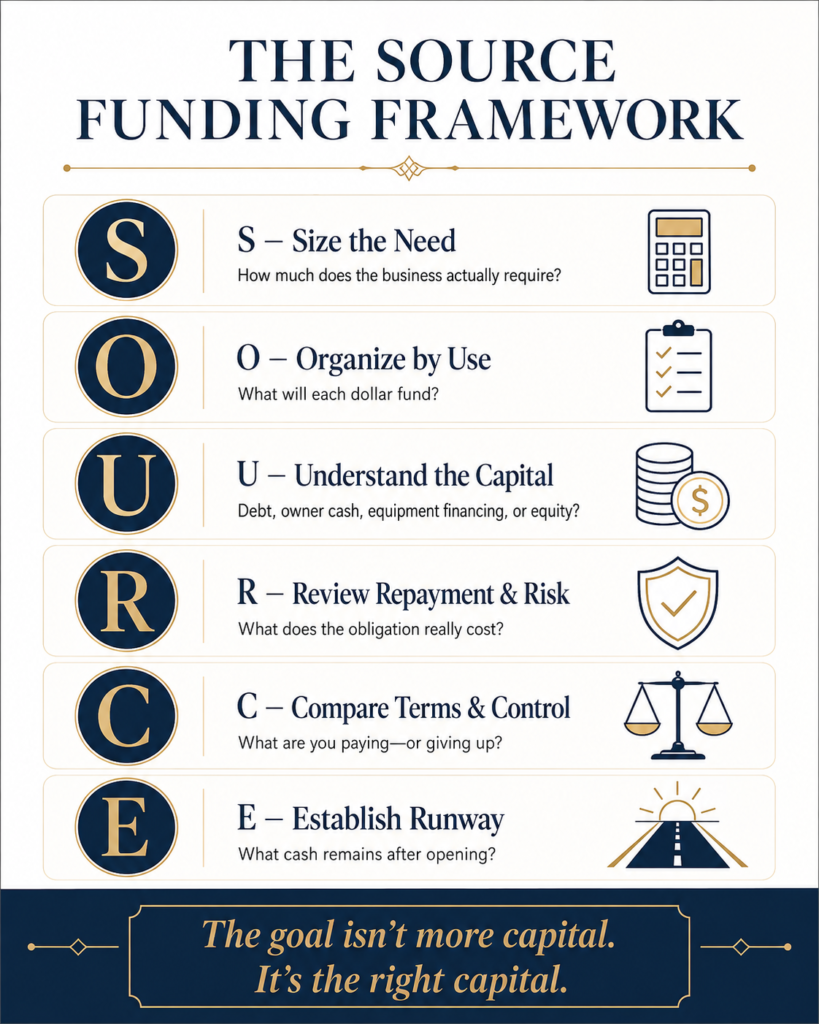
S — Size the Need Before You Look for Money
Do not start with:
“How big of a loan can I get?”
Start with:
“How much capital does this specific business actually require?”
The U.S. Small Business Administration recommends that future owners and separate one-time startup expenses from recurring monthly expenses. The purpose is to create a clearer picture of how much funding is required and when it will be needed. [1]
For an aesthetic practice, your financial model may need to account for things such as:
- Lease deposits.
- Buildout and leasehold improvements.
- Legal and accounting expenses.
- Licenses and permits.
- Insurance.
- Furniture and fixtures.
- Treatment equipment.
- Technology and software.
- Initial product and supply inventory.
- Pre-opening payroll or training.
- Marketing.
- Signage.
- Professional services.
- Debt payments.
- Operating expenses after opening.
- Contingency funds.
The exact list depends on your practice model.
A solo injectable-focused practice will not have the same capital needs as a multi-room practice launching with several expensive devices.
There is no responsible universal “cost to open a med spa.”
Build your number from the bottom up.
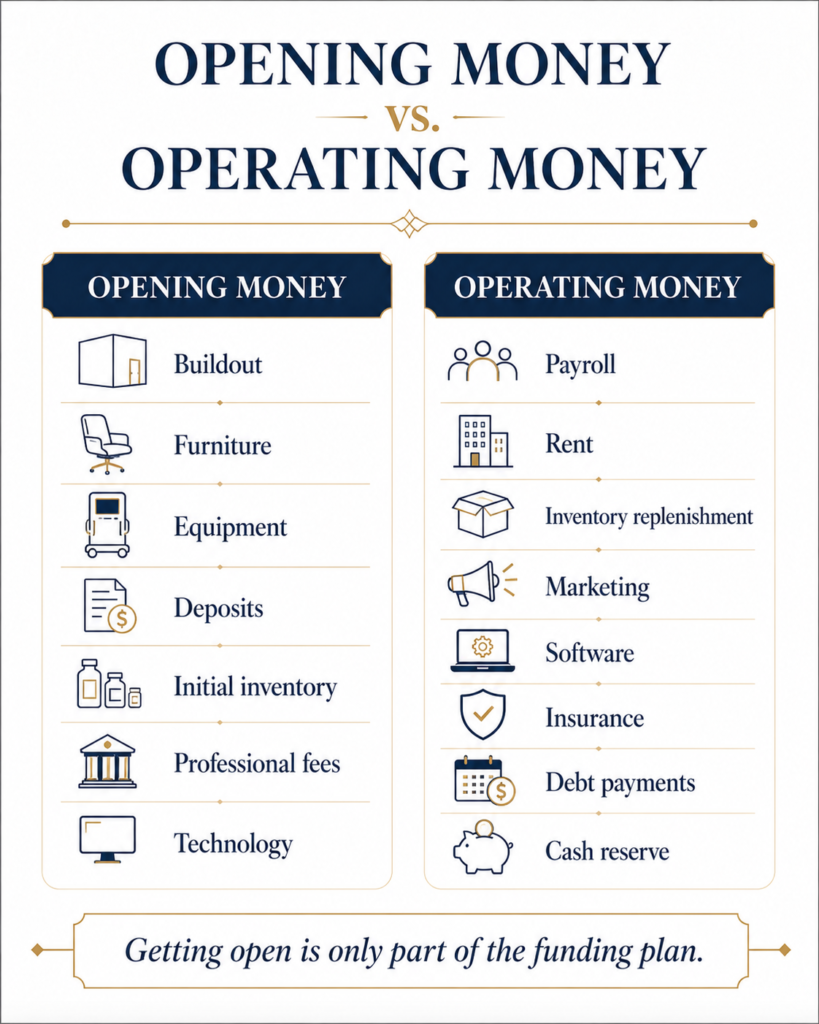
Opening Capital and Working Capital Are Not the Same Thing
This distinction is easy to miss.
Opening capital gets you to opening day.
It might pay for:
- Deposits.
- Furniture.
- Equipment.
- Construction.
- Legal setup.
- Technology.
- Initial inventory.
Working capital helps operate the business afterward.
It may need to support:
- Payroll.
- Rent.
- Replenishing inventory.
- Marketing.
- Software.
- Insurance.
- Utilities.
- Debt payments.
- Other recurring expenses while patient volume develops.
The American Med Spa Association’s guidance on the specifically recommends thinking about working capital while building the startup budget and financial projections. [2]
That is a crucial distinction.
Funding the opening is not the same as funding the ramp.
A beautiful practice that opens with almost no cash left is not necessarily well funded.
O — Organize the Money by What It Needs to Do
Once you have the full funding requirement, divide it by use.
Do not treat all capital as interchangeable.
Create buckets such as:
Fixed assets
- Real estate.
- Major buildout.
- Long-life equipment.
Opening expenses
- Deposits.
- Professional fees.
- Permits.
- Furniture.
- Technology.
- Initial setup.
Variable operating needs
- Inventory.
- Product.
- Payroll.
- Marketing.
- Supplies.
Operating runway
Cash available to support the practice while revenue develops.
Why separate these?
Because different funding tools are designed for different jobs.
A financing product that works well for a long-lived physical asset may be a poor fit for short-term inventory.
And tying up most of your cash in equipment may leave too little liquidity for payroll and marketing.
Match the life of the money to the job the money is doing.
U — Understand Your Main Funding Options
There is no single best way to finance every aesthetic practice.
The appropriate mix depends on:
- How much capital you need.
- What you are buying.
- Your credit and financial position.
- Your experience.
- Whether the practice is a startup or existing business.
- Whether real estate is involved.
- How quickly you need funding.
- How much debt you are comfortable carrying.
- Whether you are willing to give up ownership.
Here are the major categories to understand.
1. Self-Funding
Self-funding may include personal savings or other owner capital.
The obvious advantage:
You do not owe a lender principal and interest simply because you invested your own cash.
But “debt free” does not mean “risk free.”
You are moving personal capital into a business that may take time to produce reliable owner income.
Ask:
How much of my personal financial safety am I willing to expose to the business?
There is also a difference between having enough money to open and being comfortable with what remains personally afterward.
Do not empty your personal emergency plan just to avoid a business loan.
2. SBA 7(a) Financing
The is the SBA’s primary business-loan program. SBA does not generally lend the money directly; participating lenders make the loans with an SBA guarantee. [3]
For a future owner, one reason 7(a) is worth understanding is its flexibility.
Permitted uses can include:
- Real estate.
- Working capital.
- Machinery and equipment.
- Furniture and fixtures.
- Supplies.
- Certain refinancing.
- Complete or partial business acquisition.
The current maximum 7(a) loan amount is $5 million. [3]
That is a program ceiling.
It is not a recommendation for how much a new aesthetic practice should borrow.
Borrow what the financial model can justify—not what the program happens to allow.
3. SBA 504 Financing
The is designed primarily for major fixed assets, including qualifying real estate, construction or renovation, and certain long-term machinery and equipment. [4]
The current SBA maximum listed for a 504 loan is $5.5 million.
But there is an important difference:
504 proceeds generally cannot be used for working capital or inventory. [4]
That means a future owner considering real estate or substantial qualifying fixed assets may look at 504 very differently from someone whose greatest need is product, payroll, and early operating cash.
As of July 4, 2026, the SBA also allows eligible borrowers to combine 7(a) and 504 financing for up to $10 million in cumulative SBA-backed financing under the updated policy. [9]
Again:
A higher financing ceiling does not make a larger project smarter.
4. SBA Microloans
For smaller capital needs, an may be worth understanding.
Current SBA guidance says microloans can provide up to $50,000 and may be used for purposes including:
- Working capital.
- Inventory.
- Supplies.
- Furniture.
- Fixtures.
- Machinery.
- Equipment.
They cannot be used to purchase real estate or pay existing debt. [5]
A microloan is not going to fund every med spa concept.
But for a deliberately lean startup or a smaller capital gap, the category is worth knowing exists.
5. Equipment Financing or Leasing
Major aesthetic devices can consume a large portion of a startup budget.
Financing a device separately may preserve cash for other parts of the launch, but that does not automatically make financing the right choice.
Ask:
- What is the total financed cost?
- How long is the obligation?
- Is the rate fixed or variable?
- Who owns the device?
- What happens at the end of a lease?
- Are maintenance costs included?
- Are consumables tied to the agreement?
- Are there prepayment penalties?
- Does the device realistically have enough expected utilization to justify its payment?
Do not finance equipment because the salesperson showed you the monthly payment.
Evaluate the entire economic commitment.
“Only $4,000 a month” is still a very expensive sentence if the machine sits unused.
6. Conventional Bank Financing
Traditional banks may offer:
- Term loans.
- Equipment loans.
- Commercial real-estate financing.
- Lines of credit.
- Other business products.
Specific underwriting requirements vary by institution.
That is why comparing lenders matters.
The SBA’s says startup borrowers should be ready to discuss their business plan, amount and use of funds, credit history, financial projections, possible collateral, and industry experience. [6]
For a startup, the lender is not evaluating only the future practice.
They are also evaluating you.
7. Investors
Debt is not the only outside capital.
A future practice may involve:
- A business partner.
- Friends or family.
- Angel investors.
- Other equity investors.
But investor money is not simply “money you don’t have to repay.”
You may be giving up:
- Ownership.
- Future profits.
- Voting rights.
- Control.
- Decision-making authority.
- A share of future sale value.
There are also legal considerations.
The U.S. Securities and Exchange Commission explains that . Even private businesses generally must register an offer and sale of securities or qualify for an exemption. [7]
So:
“My uncle is giving me $100,000 for 10%.”
is not something to structure casually over dinner.
Use qualified legal and tax professionals before taking investor money.
8. Grants
This deserves its own section because internet searches can create false hope.
The SBA explicitly states that it . Its grant programs are generally targeted to areas such as research, entrepreneurship-support organizations, manufacturing initiatives, and exporting. [8]
That does not mean no local, private, industry, economic-development, or special-purpose grant could ever exist.
It means:
Do not build your med spa funding plan around “finding a government grant.”
If legitimate grant money appears, great.
Your business should still work without imaginary free money.
R — Review Repayment and Risk
Getting approved does not answer whether you should accept the financing.
Before signing, understand:
The repayment
- Monthly payment.
- Repayment period.
- Fixed or variable rate.
- When payments begin.
The total cost
Look beyond the monthly payment.
Understand:
- Interest.
- Origination fees.
- Closing fees.
- Broker fees.
- Other charges.
- Prepayment provisions.
Collateral and guarantees
Determine what assets support the financing and what you may be personally agreeing to.
The SBA notes that many lenders may require collateral and that startup financing decisions consider credit risk. [6]
The downside
Ask:
What happens if opening takes three months longer than expected?
What happens if revenue reaches only 60% of the original projection?
What happens if the device I financed does not generate the expected demand?
Do not model only the perfect launch.
C — Compare More Than Interest Rates
A financing comparison should include more than:
“Bank A offered 7% and Bank B offered 8%.”
You may also need to compare:
- Loan amount.
- Required owner contribution.
- Amortization.
- Rate structure.
- Fees.
- Collateral.
- Personal guarantees.
- Prepayment terms.
- Use-of-funds restrictions.
- Required reserves.
- Covenants.
- Closing timeline.
- Flexibility.
- Control.
- Ownership dilution.
For investor capital, add:
- Percentage ownership.
- Voting rights.
- Board or management rights.
- Distribution expectations.
- Future dilution.
- Exit expectations.
For equipment financing, add:
- Ownership at maturity.
- Buyout provisions.
- Maintenance.
- Consumables.
- Upgrade restrictions.
- Useful life.
Capital has a price even when that price is not called interest.
E — Establish Runway
One of the biggest questions in funding is:
How much cash should still be available after opening day?
There is no responsible universal answer such as:
“Every med spa needs exactly six months.”
The right number depends on your projected expenses, revenue ramp, debt payments, staffing, fixed costs, and risk tolerance.
The SEC’s small-business capital guidance tells companies preparing to raise investment capital to calculate the amount needed based on a thoughtfully projected runway and expenses, and to be able to explain how the proceeds will be used. [7]
That principle applies whether the money comes from investors, a bank, or you.
Build scenarios.
Base case
What happens if the launch performs roughly as expected?
Slower case
What happens if patient volume develops more slowly?
Stress case
What happens if you encounter:
- Construction delays.
- Hiring delays.
- Equipment problems.
- Unexpected legal expenses.
- Larger inventory requirements.
- Slower-than-expected bookings.
Your model should tell you how long the business can operate before it needs additional capital.
Do not discover your runway by watching the bank balance get smaller.
Improve Your Funding Readiness Before You Apply
A future owner can work on financing readiness months—or years—before opening.
The SBA notes that for a new business, lenders commonly look heavily at the owner’s personal credit history because the company does not yet have an established financial record. can therefore matter well before an application is submitted. [6]
Work on:
- Personal credit.
- Personal liquidity.
- Existing debt.
- Business planning.
- Market research.
- Revenue assumptions.
- Expense assumptions.
- Startup budget.
- Cash-flow projections.
- Ownership/legal structure.
- Professional documentation.
- Industry experience.
- A clear explanation of how funding will be used.
Do not wait until you find the perfect location to begin preparing for the money conversation.
What Should You Bring to a Lender?
Requirements vary, but expect to be asked for financial evidence—not just enthusiasm.
Potential documentation can include:
- Business plan.
- Startup budget.
- Sources and uses of funds.
- Financial projections.
- Personal financial information.
- Tax returns.
- Business documents.
- Ownership information.
- Resumes or experience.
- Equipment quotes.
- Lease or real-estate information.
- Other lender-specific documentation.
AmSpa’s med-spa financial guidance similarly recommends preparing the business plan, financial projections, personal financial information, and estimating funding and working-capital needs before approaching banking partners. [2]
You are trying to answer one fundamental lender question:
“What gives us confidence that this business can repay the money?”
Do Not Confuse Approval With Affordability
This may be the most important funding lesson.
A lender tells you:
“You’re approved.”
That means the lender has decided the transaction meets its underwriting requirements.
It does not mean:
- You need the full amount.
- The practice concept is perfect.
- Every piece of equipment is necessary.
- The monthly payment will feel comfortable.
- Your revenue projections will happen.
- Your personal risk tolerance matches the loan.
- The debt is the best use of capital.
Approval is permission to borrow. It is not a command to borrow.
The 10-Question Funding Test
Before committing to any meaningful source of capital, you should be able to answer:
- Exactly how much capital does the practice need?
- What is every major dollar being used for?
- Which costs are one-time and which continue monthly?
- How much working capital remains after opening?
- What assumptions drive the revenue forecast?
- At what revenue level does the practice approach break-even?
- What is the full cost of the financing?
- What am I personally guaranteeing or risking?
- What ownership or control am I giving away?
- What happens if the business grows more slowly than expected?
If you cannot answer those questions yet, you probably do not need a lender meeting.
You need a better financial plan.
Frequently Asked Questions
What is the best way to finance a med spa?
There is no universally best financing method.
The best structure depends on how much you need, what the money will fund, your credit and financial position, your business model, and whether you are willing to take on debt or give up equity.
A startup needing working capital has different needs from a practice buying real estate or financing one piece of equipment.
Can you use an SBA 7(a) loan to open a med spa?
Potentially.
SBA 7(a) financing can be used for purposes including starting a business, working capital, equipment, furniture, supplies, real estate, and certain acquisitions, subject to SBA and lender eligibility requirements. [3]
The lender—not Injector Success—determines whether a particular applicant and transaction qualify.
Can an SBA 504 loan pay for working capital?
Generally, no.
The current SBA 504 program is intended for qualifying fixed assets such as real estate and long-term equipment, and SBA specifically lists working capital and inventory as ineligible uses. [4]
Does my personal credit matter if the business is new?
Often, yes.
SBA startup guidance notes that new businesses do not have the established financial history of existing businesses, so loan eligibility commonly depends in part on the owner’s personal credit. [6]
Specific lender requirements vary.
Are there government grants to open a med spa?
Do not count on SBA startup grants.
The SBA explicitly states that it does not provide grants to start or expand ordinary businesses. [8]
Other narrowly targeted local, private, research, or economic-development opportunities may occasionally exist, but they should be verified individually.
Is taking an investor better than taking a loan?
Not automatically.
Debt usually requires repayment.
Equity may not require scheduled loan repayment, but you may exchange ownership, profits, control, or future sale value.
Investor transactions may also involve securities-law requirements. [7]
Compare both the financial price and control price.
How much working capital should I have before opening?
There is no universal number appropriate for every aesthetic practice.
Build a cash-flow model based on the practice’s actual recurring expenses, debt obligations, expected revenue ramp, and downside scenarios.
The answer should come from the model—not from a generic internet rule.
Where can a future owner get help preparing for financing?
The SBA and its Resource Partner network offer through organizations including Small Business Development Centers, SCORE, Women’s Business Centers, and Veterans Business Outreach Centers. [10]
These resources can be useful before paying someone to “find funding” for you.
Fund the Business You Actually Plan to Build
Funding is not the exciting part of ownership.
Nobody posts a glamorous Instagram reel about cash-flow assumptions.
But this is where future owners either become more prepared—or much more vulnerable.
Know what the practice costs.
Separate opening costs from operating capital.
Match the funding source to the use.
Understand repayment.
Understand control.
Stress-test the assumptions.
Protect the runway.
And do not borrow money simply because somebody is willing to lend it.
The goal is not to prove you can get funded. The goal is to build a practice worth funding—and a financial structure you can live with after opening day.
Explore Injector Success resources for practice ownership, financial preparation, business planning, leadership, and building toward your future practice.