
Being ready to own an aesthetic practice requires more than being a talented injector with patients who like you.
You need a reason for owning that survives the difficult parts of ownership. You need to understand whether the practice can legally be structured the way you envision, whether enough demand exists, what it will actually cost to open and operate, how long your money needs to last, and whether you are prepared to lead a business rather than simply work inside one.
That is why the question is not:
“Could I open a med spa?”
It is:
“Am I ready to build and operate one?”
Use this five-part readiness test:
Reason → Eligibility & Structure → Audience & Demand → Dollars & Runway → You as Owner
The READY Ownership Test.
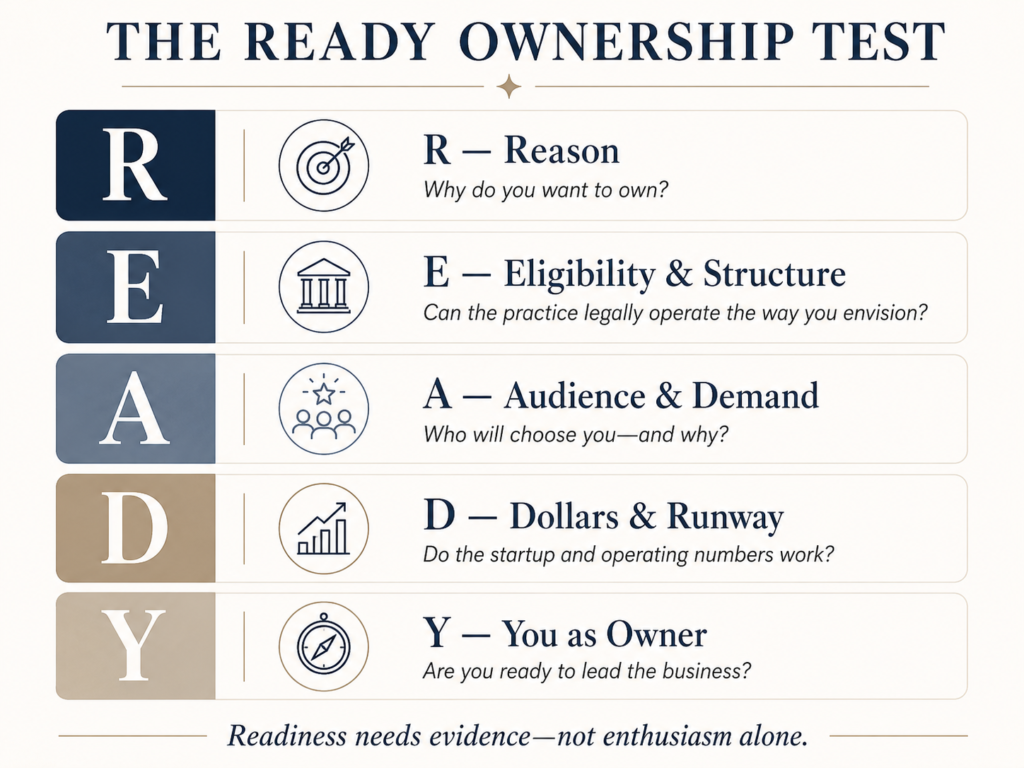
R — Start With the Reason You Want to Own
There are good reasons to consider ownership.
You may want:
- More control over the patient experience.
- Greater autonomy over your professional direction.
- The ability to build a team.
- More influence over branding and positioning.
- A long-term business asset.
- More control over your schedule.
- A path toward leadership.
- The opportunity to create something beyond your individual production.
But there are also reasons that should make you slow down.
Maybe you are tired of your manager.
Maybe you dislike your compensation plan.
Maybe another provider is making more money.
Maybe you think:
“If I’m bringing in this much revenue, I should just keep all of it.”
That last thought is particularly dangerous.
The revenue attached to your treatments is not the same thing as owner income.
A practice may need to pay for rent, payroll, payroll taxes, supplies, product, software, insurance, merchant fees, marketing, legal work, accounting, equipment, debt payments, maintenance, utilities, administrative support, and working capital before the owner ever decides what can safely be taken out.
Being frustrated with employment can be a reason to change jobs.
It is not automatically a reason to become an owner.
Ask yourself:
If my current job improved tomorrow, would I still want to build a company?
That question separates a business ambition from an escape plan.
E — Understand Whether You Can Legally Own the Practice You Imagine
Do this before you sign a lease.
Do it before ordering equipment.
Do it before choosing a name.
Do it before announcing your grand opening.
Medical aesthetics sits at the intersection of healthcare and business, and ownership requirements are not identical across the United States.
The American Med Spa Association’s current guidance on emphasizes that med-spa laws can vary substantially by state because many services are considered the practice of medicine. [1]
One major issue is the . Depending on the state and ownership model, physician ownership, professional entities, management arrangements, or other structures may come into play. [2]
That means:
RN does not automatically equal owner.
NP does not automatically equal owner.
PA does not automatically equal owner.
Physician does not mean every business structure is automatically appropriate.
The correct answer depends on the location, professional licenses involved, services offered, ownership arrangement, clinical structure, and applicable state requirements.
You also need to distinguish business entity structure from healthcare ownership rules.
The IRS recognizes common business forms including sole proprietorships, partnerships, corporations, S corporations, and state-created LLCs, but it also notes that legal and tax considerations affect the choice. [3]
A normal LLC answer from an internet forum is not enough for a medical practice.
Before proceeding, you should be able to answer:
- Who is legally allowed to own the medical entity?
- What entity or entities are appropriate?
- Who controls medical decisions?
- What professional supervision or collaboration requirements apply?
- What licenses, registrations, permits, insurance, and agreements are required?
- What can each team member legally perform?
- How can revenue legally flow between any related entities?
Those questions require qualified legal and professional advice specific to your state.
If you don’t yet know which questions to ask, you are still in the education stage—not the lease-signing stage.
A — Know Whether You Have a Market, Not Just an Instagram Audience
Liking aesthetics is not market research.
Having 8,000 followers is not market research.
Having patients tell you:
“You should open your own place!”
is encouraging.
It is still not market research.
The U.S. Small Business Administration’s guidance on recommends evaluating demand, market size, location, market saturation, pricing, competitors, and the characteristics of the customers you expect to serve. [4]
For a future aesthetic owner, that means understanding questions such as:
Who is the practice actually for?
“Anyone who wants aesthetics” is not a useful target market.
Who are the patients you understand particularly well?
What do they value?
Where do they live?
How far will they reasonably travel?
What services are they already buying?
What already exists?
Map the competitive environment.
Not just other injectors.
Look at:
- Med spas.
- Dermatology practices.
- Plastic surgery practices.
- Wellness businesses.
- Cosmetic medical practices.
- Established individual providers.
- New practices entering the market.
Why would the patient choose you?
Being friendly is not enough.
Neither is:
“We provide personalized care in a luxurious environment.”
Everyone says that.
Your concept needs a reason to exist.
What evidence do you already have?
A patient following can be valuable evidence of demand—but do not assume patients belong to you personally.
Employment agreements, restrictive covenants, patient-record ownership, non-solicitation provisions, employer policies, professional obligations, and applicable state laws all matter.
Do not build an ownership plan around taking someone else’s patient database.
Build something people will choose on its own merits.
Your Patient Following Is Helpful—but It Is Not a Business Model
An injector with a strong professional reputation enters ownership with an advantage.
You may already understand:
- Consultations.
- Patient communication.
- Retention.
- Referrals.
- Social content.
- Local reputation.
- Patient expectations.
That’s valuable.
But a practice has to continue functioning when:
- You are sick.
- You take a vacation.
- Another provider treats the patient.
- A front-desk employee resigns.
- An ad stops working.
- A device needs repair.
- Product costs rise.
- Payroll is due.
- A patient issue requires attention.
- Your schedule is full but cash is tight.
That is the difference between:
having a book of patients
and
having a business.
D — Build the Numbers Before You Build the Space
Do not start with the chandelier.
Start with the spreadsheet.
The SBA describes a , including market analysis, organization, funding needs, and financial projections. [5]
For an aesthetic practice, your plan should force you to confront questions such as:
- What does opening actually require?
- What will it cost before the first patient arrives?
- What will monthly expenses be?
- How much product and inventory are required?
- What staffing model will you use?
- What does marketing cost?
- What technology is required?
- What insurance and professional services are required?
- What debt payments will exist?
- How much capital must remain after opening day?
The SBA’s guidance on specifically distinguishes one-time costs from ongoing monthly expenses and recommends calculating enough expenses to understand how much capital will be needed and when. [5]
That last part is where future owners often need to think differently.
Opening money is not the same as operating money
Suppose you manage to pay for:
the deposit, buildout, furniture, initial inventory, software, branding, and equipment.
Great.
Now Monday arrives.
Payroll still needs to be paid.
So does rent.
Marketing.
Software.
Insurance.
Inventory replenishment.
Utilities.
Debt.
That is why working capital matters.
You need enough financial runway for the practice to become a functioning business—not merely enough money to unlock the front door.
Know Your Break-Even Point
You should know roughly what the practice needs to produce before it stops consuming cash.
The SBA defines the as the point where total revenue and total costs are equal. It also recommends break-even analysis as part of business planning and funding evaluation. [6]
In a simple service business, you might think about:
Fixed costs ÷ contribution margin = approximate break-even sales
A real medical-aesthetic practice will likely require a more detailed model because services have different product costs, provider compensation, equipment utilization, margins, and treatment frequencies.
The point isn’t to become an accountant.
The point is to stop saying:
“I think we’ll be profitable.”
and begin asking:
“At what monthly revenue level does the model work, and what assumptions get us there?”
Don’t Copy Someone Else’s Startup Budget
Search the internet and you can find med-spa startup estimates ranging from relatively lean models to more than $1 million.
That does not mean one of those numbers is “the answer.”
A practice that starts with one treatment room and primarily injectable services is financially different from a multi-room flagship location carrying multiple energy devices.
Your number depends on things like:
- Geography.
- Rent.
- Buildout.
- Square footage.
- Services.
- Equipment.
- Financing.
- Inventory.
- Staffing.
- Insurance.
- Technology.
- Professional fees.
- Marketing.
- Working capital.
Your startup budget should describe your practice—not somebody else’s article.
Know How You Will Fund It
Once you understand what the business requires, determine where the money comes from.
The SBA’s current guidance on outlines broad approaches including self-funding, investors, and loans and emphasizes that every business has different funding needs. [7]
Potential approaches can involve combinations of:
- Personal capital.
- Bank financing.
- SBA-guaranteed lending where applicable.
- Equipment financing.
- Lines of credit.
- Investors.
- Partners.
- Seller financing if buying a practice.
Each option changes the risk.
Debt has repayment obligations.
Equity means someone else owns part of the business.
Personal funding puts your own capital at risk.
Do not choose financing because someone tells you it is “easy money.”
Understand:
- Interest.
- Fees.
- Guarantees.
- Collateral.
- Ownership dilution.
- Repayment obligations.
- Covenants.
- Control rights.
- Worst-case scenarios.
Ownership financing is a financial and legal decision—not merely a way to get enough money to open.
Y — Decide Whether You Want the Owner’s Actual Job
This may be the most important part.
You know the injector’s job.
You may not yet know the owner’s job.
An owner may have to think about:
- Payroll.
- Recruiting.
- Scheduling.
- Vendor negotiations.
- Compliance.
- Marketing.
- Patient acquisition.
- Retention.
- Technology.
- Cash flow.
- Compensation.
- Employee conflict.
- Training.
- Performance management.
- Insurance.
- Legal issues.
- Accounting.
- Equipment decisions.
- Inventory.
- Leadership.
- Culture.
- Systems.
And then, after all of that:
you may still be injecting.
The internal Injector Success ownership roadmap recognizes exactly this transition, with future topics including Becoming a Leader, Not Just the Best Injector, Transitioning from Provider to Owner, hiring, accountability, delegation, SOPs, owner burnout, and building a practice that can operate without the owner.
That is the shift.
As an injector, your own performance can solve a lot.
As an owner, your performance is increasingly measured by whether other people and systems work without you doing everything yourself.
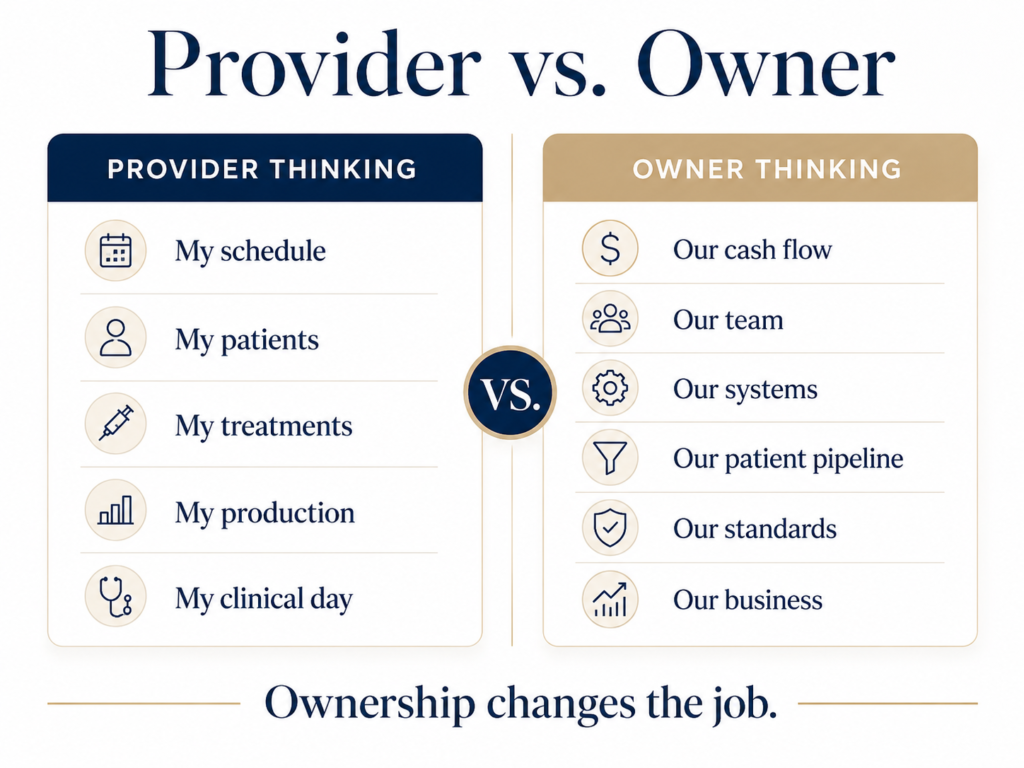
Ask Yourself Whether You Can Stop Being the Hero
Great providers are often rewarded for personally solving problems.
The patient has a question?
You answer.
The schedule has a problem?
You fix it.
Someone needs follow-up?
You do it.
A team member is confused?
You jump in.
That works when you are one provider.
It becomes dangerous when you own a company.
If every important decision, relationship, task, and patient experience has to pass through you, then you have not built a business.
You built yourself a much more complicated job.
Owner readiness includes the ability to create standards, teach other people, delegate responsibility, and hold them accountable.
Are You Financially Ready Personally?
Your business finances and personal finances are not identical.
Before taking on business risk, know your own situation.
Questions worth discussing with qualified financial and tax professionals include:
- How much personal cash are you risking?
- How long can your household function if owner income is inconsistent?
- Are you depending on the business to immediately replace your current compensation?
- What personal guarantees might financing require?
- How much debt are you comfortable carrying?
- What happens personally if opening takes longer than planned?
- Are retirement, insurance, taxes, and emergency savings being considered?
Do not build a business plan that only works if nothing goes wrong.
The READY Ownership Scorecard
Before moving from serious interest into active startup mode, see whether you can answer these questions with evidence.
R — Reason
Why do I want to own?
Would I still want ownership if it initially gave me less freedom rather than more?
E — Eligibility & Structure
Have I confirmed how this practice can legally operate in my jurisdiction?
Have qualified professionals reviewed the ownership and clinical structure?
A — Audience & Demand
Who will choose this practice—and why?
Do I have evidence beyond followers and compliments?
D — Dollars & Runway
Do I know the startup budget, monthly operating costs, break-even level, and required working capital?
Do I know where the funding comes from?
Y — You as Owner
Am I prepared to lead people and build systems?
Or do I simply want to inject without a boss?
If you cannot answer all five yet, that does not mean:
“Don’t open.”
It means:
“You found the work that needs to happen before you open.”
That is useful information.
What Should You Do Before Leaving Your Current Practice?
Do not make leaving the first step.
Preparation can happen while you are still employed.
Depending on your circumstances and agreements, that may include:
- Learning the business numbers behind your current role.
- Improving your personal financial position.
- Researching markets.
- Building a legitimate business plan.
- Understanding ownership requirements.
- Interviewing attorneys and accountants.
- Exploring funding.
- Studying operations.
- Developing leadership skills.
- Learning how practices acquire and retain patients.
- Building your professional reputation ethically.
- Reviewing any employment or restrictive agreements before taking action.
The SBA also provides . [8]
You do not need to figure out every part alone.
Frequently Asked Questions
How do I know if I’m ready to open a med spa?
You are closer to readiness when you understand why you want ownership, how the business can legally be structured, who the target patient is, what the business will cost, how it reaches break-even, where the funding comes from, and how you will lead the operation.
Clinical skill alone does not answer those questions.
Do I need a big patient following before opening my own practice?
Not necessarily.
A strong patient following and reputation may help create early demand, but you still need a viable market, compliant patient-acquisition strategy, adequate capital, and a practice that can eventually function beyond your personal schedule.
Do not assume patients from an employer automatically become yours.
Can an RN or NP own a med spa?
There is no single nationwide answer.
, and some jurisdictions restrict ownership of medical practices or require particular professional entities or ownership arrangements. [2]
Seek qualified legal advice for the specific state, licenses, services, and ownership arrangement involved.
How much money do I need to open a med spa?
There is no credible universal number.
The total depends heavily on your space, buildout, market, services, equipment, staffing, insurance, licensing, technology, professional fees, marketing, inventory, financing, and required working capital.
Build a bottom-up startup budget instead of relying on a generic online average.
Do I need a med spa business plan?
If you are seriously considering ownership, yes—a useful one.
The SBA recommends business planning to clarify structure, market, operations, funding needs, and financial projections. [5]
The purpose is not to create a beautiful document.
It is to force the assumptions into the open.
Should I leave my injector job before building the business?
Usually, leaving should not be the first planning step.
Your employment agreement, financial runway, business plan, ownership structure, funding, market analysis, and launch timeline should be understood before making an irreversible career move.
Individual circumstances vary, and employment or restrictive agreements should be reviewed with qualified counsel.
Is owning a med spa the natural next step for every successful injector?
No.
Ownership is one career path.
A provider can build an exceptional career through employment, leadership, education, management, speaking, advanced professional roles, compensation growth, or other opportunities without ever owning a practice.
Injector Success explicitly treats ownership as an option within a broader career journey—not the only definition of success.
You Don’t Have to Open Yet to Start Thinking Like an Owner
Ownership readiness does not begin when you sign a lease.
It begins when you start asking better questions.
Why do I want this?
Can I legally structure it?
Who will choose us?
What do the numbers need to do?
How much runway do I need?
How will patients find us?
Who will I hire?
What happens when I’m not in the room?
What kind of leader will I need to become?
Those questions may strengthen your desire to own.
They may tell you to wait.
They may even tell you that ownership is not the career you actually want.
All three outcomes are useful.
The goal isn’t to open a practice as quickly as possible. It’s to become the kind of future owner who understands what they’re getting into before the doors open.
Explore Injector Success resources for preparing for ownership, building your reputation, understanding the business side of aesthetics, and intentionally owning your future.