
Becoming known in your local community does not require becoming the biggest influencer in town.
It requires becoming recognizable for the right reasons.
For an aesthetic provider, that means the right patients, professionals, business owners, community leaders, and colleagues gradually learn who you are, what you care about, how you communicate, and why they should feel comfortable mentioning your name when someone asks for an aesthetic resource.
That distinction matters.
In a global exploratory study of cosmetic injectable patients, qualifications and training ranked first among seven factors contributing to trust in an injector. Reputation or recommendation ranked second. Active online presence and social-media following ranked last among the factors measured. [1]
So stop asking:
“How do I get everybody to notice me?”
A better question is:
“How do I become useful, credible, and memorable to the right people around me?”
A simple framework is:
Lead With Usefulness → Own Your Identity → Connect → Appear Consistently → Let Relationships Compound.
That is the LOCAL Reputation Loop.
1. Become Known for Something Before Trying to Become Known Everywhere
If someone asks a local colleague about you, what do you want them to say?
“She explains things incredibly well.”
“He’s thoughtful and never makes people feel pressured.”
“She really understands first-time aesthetic patients.”
“He’s always involved in the community.”
“She is one of the most reliable people I know.”
Those statements are more useful than:
“I’ve seen her Instagram.”
Your local reputation needs an association.
Choose a few qualities you genuinely want attached to your name.
Maybe you want to become known for:
- Clear patient education.
- Thoughtful consultations.
- Professionalism.
- Honest recommendations.
- A particular professional interest.
- Excellent communication.
- Community involvement.
- Reliability.
- Continued learning.
- Helping other professionals understand aesthetic medicine.
Do not invent expertise you have not earned.
A newer provider does not need to pretend to be the most experienced injector in town.
You can become known for being prepared, thoughtful, ethical, curious, dependable, and serious about improving.
Fame is vague. Reputation is specific.
2. Lead With Usefulness Before Promotion
One of the fastest ways to become forgettable at a networking event is to immediately start selling.
“What do you do?”
“I do Botox and filler. Here’s my card.”
Conversation over.
Instead, become useful.
Maybe a bridal professional regularly hears questions about when clients should begin planning aesthetic appointments before a wedding.
Maybe a fitness professional gets questions about appearance and wellness that fall outside their scope.
Maybe a salon owner wants a trustworthy aesthetic resource when clients ask questions.
Maybe a local women’s organization needs a speaker who can explain aesthetic medicine without turning the presentation into a commercial.
You do not need to turn every interaction into an appointment.
You need people to think:
“That’s someone I would feel comfortable asking.”
That matters because reputation and recommendation are meaningful parts of patient trust in cosmetic injectables. [1]
The first goal of community visibility is not conversion.
It is credibility plus familiarity.
3. Connect With People Your Community Already Trusts
You do not have to build local visibility one stranger at a time.
Communities already contain networks of trust.
Depending on your role, employer policies, market, and professional boundaries, relevant relationships might include:
- Hair stylists and salon owners.
- Estheticians.
- Fitness professionals.
- Wellness businesses.
- Bridal professionals.
- Photographers.
- Realtors and luxury-service professionals.
- Local business owners.
- Women’s organizations.
- Charitable organizations.
- Professional associations.
- Other healthcare professionals.
- Plastic surgery or dermatology practices where an appropriate professional relationship makes sense.
Do not walk in asking:
“Can you send me patients?”
Build the relationship first.
Ask about their business.
Learn what their clients ask them.
Look for an appropriate way to help.
Introduce people when you can.
Attend what they are doing.
Share something useful.
Follow up.
Networking works better when you stop treating every new person like a lead.
4. Build a Referral Network Without Making Every Relationship Transactional
A strong local network eventually creates introductions.
But the best relationships are not:
“I’ll give you something if you send someone to me.”
They are:
“I know this person. I trust how they conduct themselves. They’re worth knowing.”
That distinction becomes especially important in healthcare-related work.
Referral, compensation, fee-sharing, gift, employer, and professional rules can vary by profession and jurisdiction. If any proposed relationship involves payment, discounted services, free treatment, or another benefit, make sure it complies with applicable requirements and employer policies.
And if a local creator, professional, or business receives something of value in return for promoting a practice or service, U.S. FTC guidance requires material connections to be clearly disclosed where applicable. [7]
The relationship should still make sense without the incentive.
That is a good test.
5. Make Your Online Presence Confirm Your Local Reputation
People may meet you in person and then search for you.
Or they may find you online before you ever meet.
The two versions of you should match.
If you are working through a practice, make sure the information you are authorized to control is accurate:
- Your professional bio.
- Credentials.
- Practice location.
- Professional photo.
- Areas of legitimate interest.
- Contact or booking path.
- Social profiles.
- Practice/provider website pages.
Google says local results are primarily influenced by relevance, distance, and prominence, and recommends complete and accurate business information, reviews, and current photos for eligible business profiles. [3]
For providers considering a separate Google Business Profile, do not simply create one because it sounds helpful.
Google has specific rules for individual practitioners. A practitioner generally needs to be public-facing and directly contactable at the verified location during stated hours, and Google also provides specific guidance for multiple practitioners and branded organizations. [4]
If you are employed, coordinate with the practice before creating or changing business listings.
Local visibility should strengthen the practice relationship—not create confusion about who you represent.
6. Use Social Media to Reinforce Your Real-World Reputation
Local reputation building does not mean abandoning social media.
It means giving social media a better job.
Instead of only posting:
“Appointments available!”
“Book now!”
“Two spots left!”
show people what your professional presence actually looks like.
Share:
- Useful patient education.
- Appropriate community involvement.
- Local events you are participating in.
- Professional education you attended.
- Questions patients commonly ask.
- Local organizations you genuinely support.
- Collaborative educational content.
- Professional milestones.
- Your philosophy around communication and patient experience.
A cross-sectional study involving 491 respondents across three U.S. cities found that certain unprofessional physician social-media behaviors could reduce patient trust. [5]
AMA ethics guidance for physicians likewise emphasizes protecting confidentiality, maintaining professional boundaries, monitoring online information, disclosing financial interests, and ensuring healthcare information shared online is useful and accurate. [6]
Those standards are physician-specific and should not be treated as a universal rulebook for every RN, NP, PA, or other professional.
But the larger lesson applies:
Your online behavior becomes evidence about your professional reputation.
Post accordingly.
7. Show Up Where Real Relationships Can Form
There is still tremendous value in being physically present in your community.
Consider opportunities such as:
- Chamber or business-network events.
- Professional association meetings.
- Wellness events.
- Community fundraisers.
- Women’s organizations.
- Bridal events.
- Appropriate health fairs.
- Local educational programs.
- Charity initiatives you genuinely care about.
- Collaborative educational evenings.
- Local business openings and celebrations.
But do not judge an event only by how many appointments it generates that night.
You may meet:
One patient.
One local business owner.
One photographer.
One event organizer.
One professional who later introduces you to ten other people.
That may be far more valuable than collecting 50 email addresses from people who barely remember meeting you.
Community reputation grows through repeated encounters.
One appearance can introduce you.
Consistency makes you familiar.
8. Become Easy to Recommend
People struggle to refer someone they cannot clearly describe.
Give your network language.
Not a rehearsed pitch.
A clear professional identity.
Instead of:
“She’s an injector.”
You want people to naturally be able to say:
“She’s an aesthetic provider who is really good at explaining things.”
or:
“Talk to him. He’s very thoughtful and won’t pressure you.”
That is where local reputation begins turning into preference.
CIPEES Part 2 found that trust in the practitioner’s actions and ability ranked first among reasons respondents gave for returning to a previous injector, with previous cosmetic results close behind and connection/understanding ranking third. [2]
In other words:
Being known can get you considered.
Being trusted gives the relationship somewhere to go.
9. Build Reviews Honestly
Local reputation increasingly exists both offline and online.
Reviews can help prospective patients understand what working with a practice or provider may feel like, and Google explicitly notes that reviews and helpful responses can help businesses stand out in local results. [3]
But do not manipulate them.
The FTC’s Consumer Reviews and Testimonials Rule prohibits fake or false reviews and prohibits businesses from conditioning incentives on reviews expressing a particular positive or negative sentiment. [8]
So:
Ask appropriately.
Make it easy.
Respect honest feedback.
Do not buy praise.
Do not manufacture social proof.
A reputation worth building is also worth protecting.
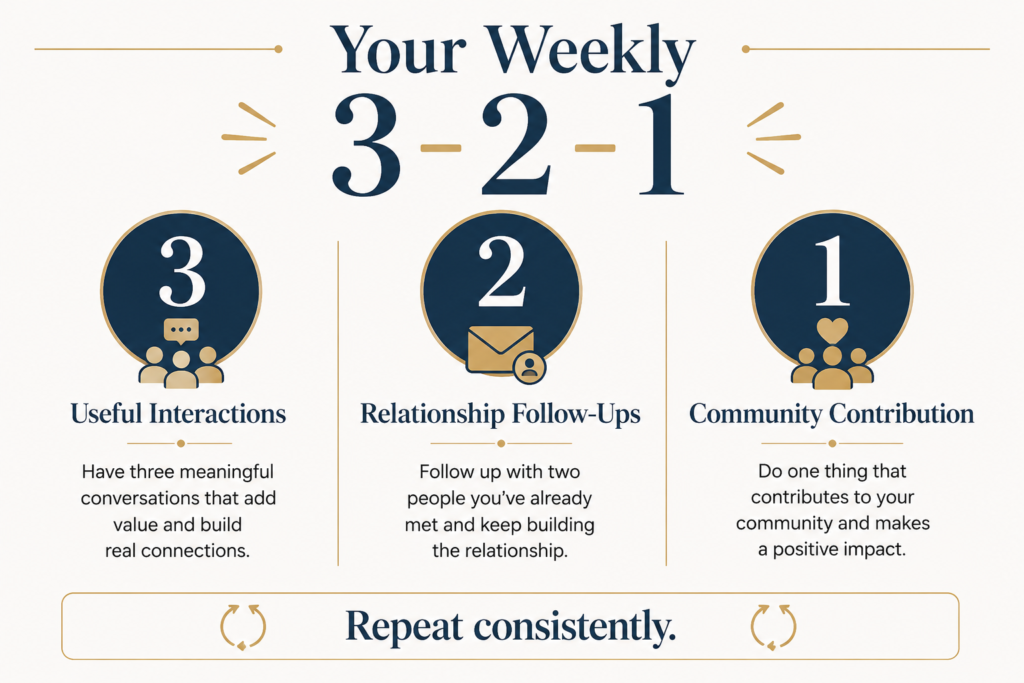
10. Use the 3-2-1 Local Visibility Rhythm
You do not need a complicated community-marketing calendar.
Start with this every week:
3 useful interactions
Contribute genuinely to three conversations involving local professionals, organizations, patients, or community groups.
2 relationship follow-ups
Follow up with two people you already know.
Not:
“Any referrals?”
Try:
“Great meeting you last week. I enjoyed our conversation about your upcoming event.”
Relationships die when nobody continues them.
1 community contribution
Do one thing that adds value locally.
That might be:
- Attend an event.
- Support an organization.
- Make an introduction.
- Collaborate on educational content.
- Offer to speak.
- Share a local business.
- Help promote someone else’s useful event.
- Participate in something your practice supports.
3 useful interactions.
2 follow-ups.
1 contribution.
Repeat.
That is far more sustainable than trying to become locally famous in thirty days.
How Do You Know Whether You’re Becoming Known?
Do not measure local reputation only by follower count.
Track signs that the community is beginning to remember and recommend you.
Useful indicators might include:
- Patients requesting you by name.
- Local referrals.
- Referral source diversity.
- Invitations to events.
- Speaking invitations.
- Introductions from other professionals.
- Collaborative opportunities.
- Reviews mentioning you appropriately.
- Local businesses interacting with your content.
- Branded searches for your name.
- Profile or practice-page traffic.
- Google Business Profile interactions where relevant and available.
- Patients mentioning where they heard about you.
Do not invent a universal benchmark.
Build your baseline.
Then watch the direction.
Frequently Asked Questions
Do aesthetic injectors need a large local following to become well known?
No.
Social media can increase visibility, but aesthetic-patient research found that active online presence and follower count ranked below qualifications, reputation/recommendation, consultation time, comfort, and previous work among the measured factors contributing to trust. [1]
A smaller local audience that understands and trusts your professional reputation may be more valuable than a large audience that barely knows who you are.
What local businesses should an injector network with?
Look for complementary organizations that serve overlapping audiences without creating inappropriate professional conflicts.
Depending on the market, those might include salons, spas, fitness businesses, bridal professionals, photographers, wellness professionals, community organizations, luxury-service businesses, and appropriate healthcare relationships.
The goal is not to collect referral partners.
The goal is to build useful professional relationships.
Can an employed injector build a local personal brand?
Yes, but the personal brand should complement rather than compete with professional obligations.
Understand your employer’s policies regarding social media, patient relationships, photography, outside events, partnerships, marketing, and use of the practice’s name.
Do not build your reputation by poaching patients or undermining your employer.
Injector Success specifically treats personal branding as something that should complement professional obligations and patient trust.
Should an injector have their own Google Business Profile?
Possibly, but not automatically.
Google permits certain public-facing individual practitioners to have dedicated Business Profiles when eligibility requirements are met. It also provides different guidance for solo practitioners and locations containing multiple practitioners. [4]
Review the current Google rules and coordinate with your employer or practice before creating anything.
Are local events worth doing?
They can be, particularly when they put you in repeated contact with relevant local people and create genuine relationships.
Do not evaluate every event only by same-day appointments.
Also look at introductions, follow-up conversations, partnerships, invitations, and long-term relationships.
How long does it take to become known locally?
There is no credible universal timeline.
It depends on your market, existing network, patient volume, professional role, reputation, consistency, and how meaningfully you participate.
Think in terms of repeated evidence over time, not a 30-day popularity campaign.
Become the Name People Feel Comfortable Mentioning
You do not need your entire city to know you.
You need the right people to understand what you stand for.
Be useful.
Be clear about what you want to be known for.
Build genuine relationships.
Show up consistently.
Make your online reputation match the person people meet offline.
Then stay involved long enough for familiarity to become trust.
You don’t become locally known by announcing that you’re important. You become known because enough people have a reason to remember—and recommend—you.
Explore Injector Success resources for building your reputation, professional visibility, patient following, and long-term career.
External Sources Used in the Article
[1] Cosmetic Injectable Patient Experience Exploratory Study—Part 3
Qualifications/training, reputation/recommendation, consultation time, and other factors contributing to trust.
[1] CIPEES Part 3 — Oxford Academic
[2] Cosmetic Injectable Patient Experience Exploratory Study—Part 2
Trust, results, connection, patient experience, and return patronage.
[2] CIPEES Part 2 — PubMed Central
[3] Google Business Profile — Improving Local Ranking
Local ranking factors, complete business information, reviews, photos, relevance, distance, and prominence.
[3] Google — Improve Your Local Ranking
[4] Google Business Profile — Individual Practitioner Guidelines
Eligibility and profile rules for public-facing individual practitioners.
[4] Google — Business Profile Guidelines
[5] The Impact of Physician Social Media Behavior on Patient Trust
Cross-sectional research examining how physician social-media behavior may affect patient trust.
[5] PubMed — Physician Social Media and Patient Trust
[6] AMA Code of Medical Ethics — Physicians’ Use of Social Media
Professional reputation, privacy, boundaries, disclosures, and accuracy online.
[6] AMA — Physicians’ Use of Social Media
[7] FTC — Disclosures 101 for Social Media Influencers
Disclosure requirements for material connections in endorsements.
[7] FTC — Social Media Disclosure Guidance
[8] FTC Consumer Reviews and Testimonials Rule
Fake reviews, incentivized reviews, review manipulation, and testimonials.
[8] FTC — Consumer Reviews and Testimonials Rule Q&A