A consultation that converts is not one that gets every patient to say yes.

It is a structured conversation that helps an appropriate patient understand what they want, what may realistically help, what the provider recommends, and what the logical next step should be.
Sometimes that next step is treatment.
Sometimes it is waiting.
Sometimes it is changing the plan.
And sometimes the right answer is not to proceed at all.
That distinction matters because the strongest aesthetic consultations are built around trust and clarity—not pressure.
Research involving cosmetic injectable patients found that qualifications and training were the highest-ranked contributor to injector trust, followed by practitioner reputation and the time and explanation provided during the consultation and procedure. [1]
Broader healthcare research published in 2026 also found that clear information, empathy, active listening, shared decision-making, and supportive nonverbal communication were generally associated with greater patient trust. [2]
So if you want to improve your consultation conversion, do not start by memorizing a closing script.
Start by making the consultation better.
A simple framework is:
Connect → Listen → Educate → Advise → Resolve
What Does “Conversion” Actually Mean in an Aesthetic Consultation?
Practices often use conversion to mean:
Consultation → treatment booked.
That is useful as a business metric.
But it is incomplete as a measure of consultation quality.
An appropriate patient who understands the recommendation and confidently schedules treatment may represent a successful consultation.
So can a patient who realizes the treatment they originally requested is not right for them.
So can someone who needs more time.
So can an appropriate decision not to treat.
AHRQ describes shared decision-making as a collaborative process in which clinicians and patients combine evidence, professional knowledge, and the patient’s goals, preferences, and circumstances to determine the best path forward. [6]
Pressure can produce a yes. It cannot produce trust.
Your goal is a clear decision.
Not a forced decision.
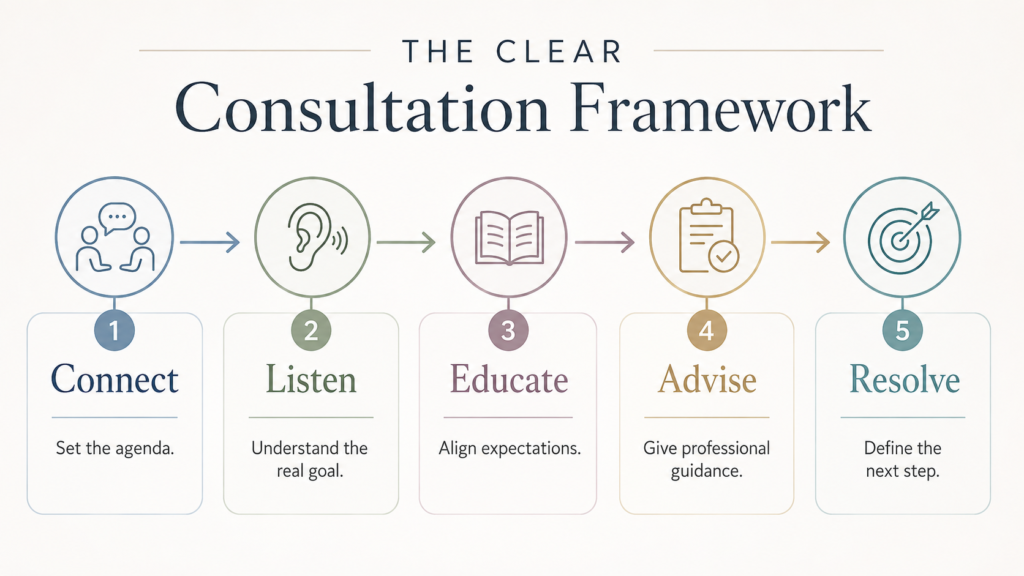
C — Connect and Set the Agenda
Patients should not have to spend the first five minutes wondering what is supposed to happen.
Create structure immediately.
Welcome the patient.
Sit down when appropriate.
Give them your attention.
Then explain the purpose of the conversation in plain language.
For example, the consultation might involve:
- Understanding what brought them in.
- Discussing what they want to change.
- Exploring relevant expectations and concerns.
- Reviewing appropriate options.
- Giving your professional recommendation.
- Agreeing on what happens next.
The exact process will vary by provider, practice, procedure, licensure, and jurisdiction.
The principle does not.
The patient should know that you are trying to understand before you recommend.
The PEAK Aesthetic Consultation model published in Plastic and Aesthetic Nursing similarly emphasizes prioritizing the patient’s story, education and expectations, treatment discussion, and longer-term planning. [5]
Structure creates confidence.
It also prevents the consultation from turning into twenty minutes of random questions followed by a rushed recommendation at the end.
L — Listen for the Real Goal
A patient who says:
“I want filler.”
has told you what they believe the solution is.
They have not necessarily told you what the problem is.
A productive consultation needs to uncover things such as:
- What specifically bothers them?
- Why are they addressing it now?
- What change are they hoping to see?
- What would feel like too much?
- Have they had previous treatment?
- What did they like or dislike about previous experiences?
- What concerns them most?
- Is there an event or deadline affecting the decision?
- What does a successful outcome mean to them?
This matters because aesthetic patients are not one psychological profile.
CIPEES Part 1 found meaningful variation in aesthetic preferences and motivations. Although most respondents favored natural-looking results, a meaningful minority considered a more visibly treated appearance acceptable or desirable. [3]
In other words:
Do not hear the word “natural” and assume you know exactly what the patient means.
Ask.
Listen.
Then confirm what you heard.
That last step is easy to skip.
Try:
“Let me make sure I’m understanding what matters most to you.”
Then summarize.
You will often discover that the treatment request is not really the main issue.
The goal is.
E — Educate and Align Expectations
Once you understand the patient’s goal, education becomes useful.
Before that, it can become noise.
A provider who immediately launches into products, anatomy, treatment names, units, syringes, devices, packages, and pricing may technically provide a lot of information while still leaving the patient confused.
Good education answers the questions the patient actually needs answered.
Depending on the situation and the provider’s scope, that may include:
- What options may be appropriate.
- Why one option may make more sense than another.
- What realistic outcomes might look like.
- Important limitations.
- Relevant risks and considerations.
- What the process involves.
- What happens afterward.
- What alternatives exist.
- Whether doing nothing is a reasonable option.
A 2026 review focused specifically on aesthetic surgery communication concluded that aesthetic goals can be difficult for patients to articulate and highlighted expectation management, structured communication, visual tools, and decision support as important parts of aligning patient and provider understanding. [4]
The research is surgical rather than injectable-specific, so it should not be treated as a direct injector benchmark.
But the principle transfers well:
Unclear expectations create fragile decisions.
Do not simply ask:
“Does that make sense?”
A nervous patient will often say yes.
Instead ask something that checks actual understanding:
“What questions do you still have?”
or:
“How does that compare with what you were expecting?”
You are looking for alignment, not polite agreement.
A — Advise With Professional Judgment
One of the easiest ways to weaken a consultation is to give the patient a giant menu.
“You could do this, this, this, this, or this. What do you want?”
That can feel like choice.
It can also feel like abandonment.
Patients came to a professional because they want professional judgment.
After listening and assessing appropriately, explain what you recommend and why.
That does not mean the provider dictates the decision.
Shared decision-making involves patient participation, but participation works best when the provider contributes meaningful expertise rather than simply handing every decision back to the patient. https://pubmed.ncbi.nlm.nih.gov/37001002/
A strong recommendation has three parts:
1. What you recommend
Be clear.
2. Why
Connect it directly to the patient’s stated goal.
3. What the patient should realistically understand
Clarify expectations, limitations, alternatives, and the next step.
This is also where education can reduce unnecessary uncertainty.
One quality-improvement project involving new patients seeking cosmetic injections found that adding a preprocedural educational video improved patient confidence and satisfaction while reducing provider consultation time. [7]
That does not mean every practice needs a video or that a video substitutes for provider consultation.
It does suggest something useful:
Patients make better decisions when basic education is delivered clearly and consistently.
Your website, pre-consult materials, FAQs, videos, and staff communication can do some of that work before the provider ever walks into the room.
R — Resolve the Next Step
Too many consultations simply fade out.
The provider gives a recommendation.
The patient says:
“Okay, I’ll think about it.”
Everybody smiles.
Appointment over.
No one knows what happens next.
You do not need an aggressive closing line.
You do need clarity.
If the patient is ready and treatment is appropriate, explain the next step.
If they are hesitant, find out what remains unresolved.
Instead of immediately overcoming an “objection,” ask:
“What would you still need to feel comfortable making a decision?”
Maybe it is price.
Maybe it is downtime.
Maybe it is fear.
Maybe expectations are still unclear.
Maybe they need to speak with someone.
Maybe they are simply not ready.
Those are different situations and should not receive the same canned response.
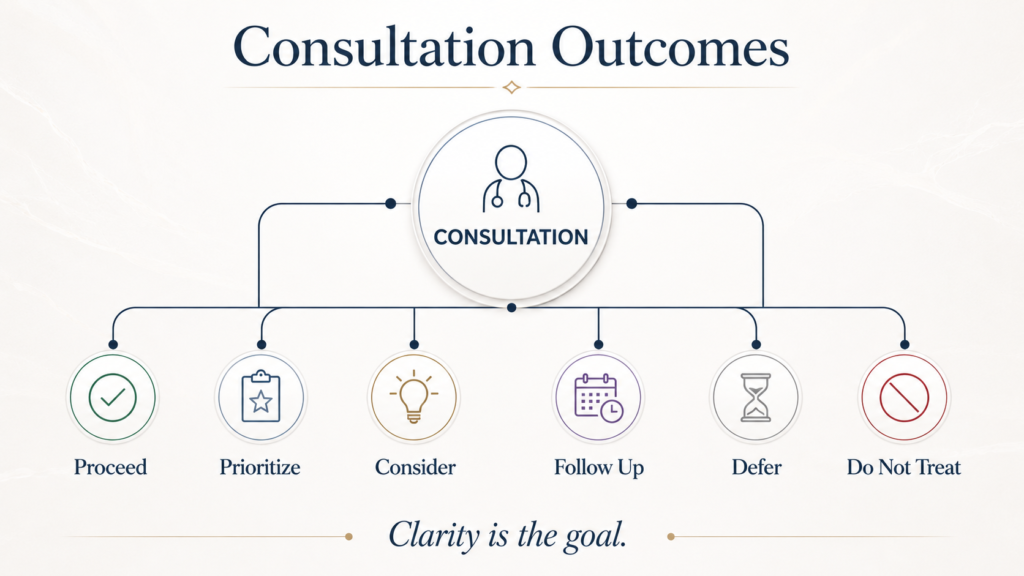
A successful end to the consultation might be:
Proceed: the patient understands and wants to move forward.
Prioritize: the patient has several goals and agrees which one comes first.
Consider: the patient understands the recommendation but needs time.
Follow up: a specific next conversation is appropriate.
Defer: the timing is not right.
Do not treat: treatment is not appropriate.
Do not make the patient feel that only the first outcome counts.
Do Great Consultations Actually Improve Patient Loyalty?
Consultation skill matters beyond the first purchase.
CIPEES Part 2 examined why cosmetic injectable patients returned to a previous provider. Trust in the practitioner’s actions and ability ranked first, narrowly ahead of the cosmetic result from the previous treatment, with connection and understanding ranking third. [8]
That finding should not be twisted into:
“Results do not matter.”
Of course they matter.
The better conclusion is:
Patients experience the result and the provider relationship together.
The consultation is one of the first places that relationship is either strengthened or weakened.
How Should You Measure Consultation Conversion?
Track it.
Just do not worship it.
A simple practice may track:
Treatment conversion rate = eligible consultations resulting in treatment scheduled ÷ eligible consultations × 100
But also record why consultations do not move forward.
Useful outcome categories could include:
- Treatment scheduled.
- Patient considering.
- Budget or timing delay.
- Different treatment or plan recommended.
- Patient declined.
- Provider determined treatment was not appropriate.
- Referral or alternative next step.
- Follow-up required.
That context matters.
Imagine two providers:
Provider A converts 90% of every person who sits down.
Provider B converts 70% but regularly identifies unrealistic expectations, recommends less treatment when appropriate, and occasionally tells a patient no.
The higher number alone does not tell you who is running the better consultation.
A conversion metric should help you diagnose the process. It should never become pressure to treat.
Establish your own baseline.
Then look for patterns.
Are patients confused?
Are recommendations unclear?
Is pricing introduced badly?
Are consultations rushed?
Are too many choices being presented?
Does nobody ask for a next step?
Are patients leaving with unresolved questions?
Those are useful problems to solve.
Frequently Asked Questions
What makes an aesthetic consultation convert?
A strong consultation builds enough trust and clarity for the patient to reach an informed next decision. That usually requires listening, understanding the patient’s goals, explaining appropriate options clearly, setting realistic expectations, offering professional judgment, and defining the next step. Research supports the importance of trust, time, explanation, active listening, and shared decision-making. [1][2]
Should every consultation result in treatment?
No.
An appropriate decision not to treat, defer treatment, change the plan, or seek another option can be the right consultation outcome.
Patient suitability and applicable professional requirements come before conversion.
How can an injector recommend treatment without sounding salesy?
Start with the patient’s stated goal rather than the treatment you want to sell.
Explain:
What you recommend → why you recommend it → what the patient should realistically expect.
When the recommendation clearly follows the discovery conversation, it feels more like professional guidance and less like a pitch.
What if the patient says, “I need to think about it”?
Do not immediately launch into objection handling.
Ask what remains unresolved.
A patient who needs clarification requires a different response than someone who needs time, has budget concerns, is afraid, or simply does not want to proceed.
What is a good med spa consultation conversion rate?
There is no single independently validated consultation-conversion benchmark that should be treated as universal across practices, providers, services, patient populations, and definitions of “conversion.”
Track your own baseline consistently and improve it without incentivizing inappropriate treatment.
Can patient education improve consultations?
Potentially.
A small quality-improvement project involving new cosmetic-injection patients found that preprocedural video education improved confidence and satisfaction and reduced consultation time. [7] It was a specific quality-improvement project, not proof that one format works universally.
A Consultation Should Make the Decision Clearer
The best consultation is not the one with the slickest script.
It is the one where the patient leaves understanding:
What they are trying to accomplish.
What you recommend.
Why.
What they should realistically expect.
And what happens next.
That level of clarity builds trust.
Trust strengthens patient relationships.
And stronger patient relationships can build careers.
A consultation that converts does not push the patient toward your answer. It helps the right patient reach the right answer with you.
Explore Injector Success resources for building stronger consultations, patient trust, professional reputation, and long-term career value.