Building your personal brand as an injector starts with deciding what you want patients, colleagues, employers, and your professional community to associate with your name. Then you need to give them consistent evidence that those associations are deserved.
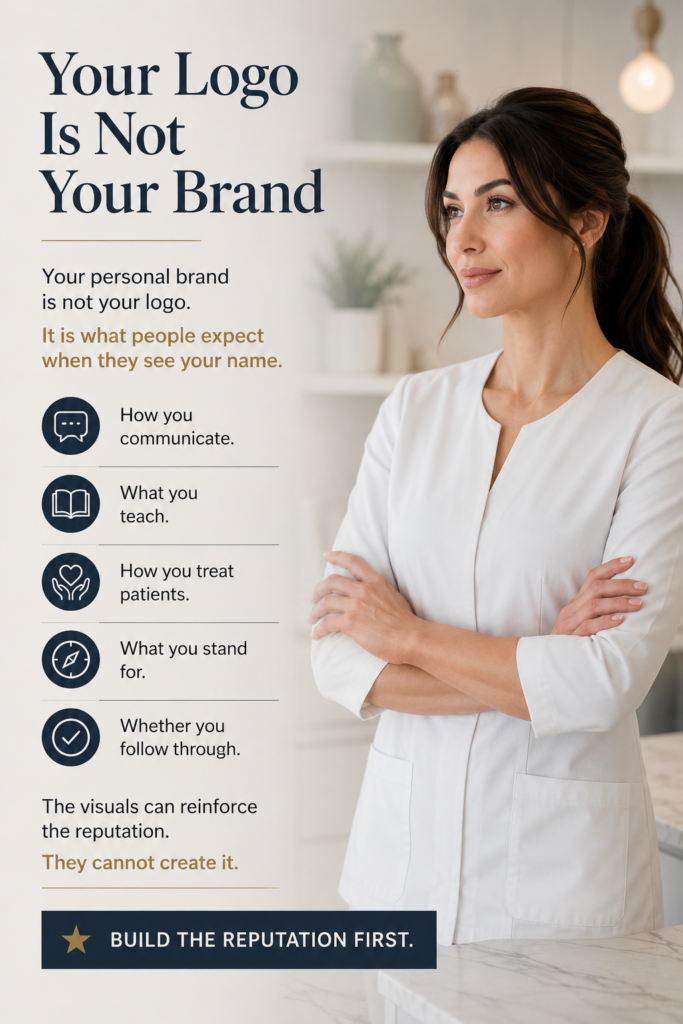
Your personal brand is not your logo, color palette, Instagram grid, headshot, or follower count. Those things can communicate a brand. They cannot create one.
A useful framework is:
Position → Proof → Presence → Experience → Reputation
Personal branding works when what you say about yourself and what people actually experience from you begin telling the same story.
1. Start With the Reputation You Want, Not the Logo You Want
Ask an injector what their brand looks like and you may hear:
“Clean.”
“Luxury.”
“Natural.”
“Modern.”
“High-end.”
Those describe aesthetics.
They do not necessarily describe a reputation.
A stronger question is:
What do you want people to say about you when you are not in the room?
Maybe you want patients to say:
“She explains things without making me feel stupid.”
“He never pressures me.”
“She is incredibly thorough.”
“I trust him to tell me when I do not need something.”
Or perhaps you want colleagues to associate you with preparation, reliability, patient education, leadership, or continued learning.
That is much closer to personal branding.
A logo can make you look branded. It cannot make you worth remembering.
Write down three qualities you genuinely want associated with your professional name.
Not ten.
Three.
Those become the beginning of your positioning.
2. Decide What You Want to Be Known For
Strong brands make it easier for people to answer:
“What is this person about?”
That does not mean forcing yourself into a microscopic niche.
You can develop a recognizable point of view around:
- Patient education.
- Thoughtful consultations.
- Realistic expectations.
- A particular professional interest.
- Natural-looking aesthetic goals.
- Communication.
- Patient experience.
- A certain demographic or community you understand particularly well.
- Continued professional development.
- Leadership or education within the profession.
Your position should come from something real.
Do not declare yourself an expert in something simply because it sounds marketable.
And do not manufacture a “signature” approach that exceeds your actual experience.
A newer injector can still have a clear professional identity.
Being known as prepared, honest, curious, highly committed to learning, and excellent at explaining things is a legitimate reputation to build.
3. Build Proof Before You Promote Yourself
Visibility and credibility are different.
That distinction matters enormously in aesthetics.
The Cosmetic Injectable Patient Experience Exploratory Study asked patients which factors helped them trust an injector. Qualifications and training ranked first, followed by practitioner reputation and the time spent with the patient. Online presence ranked last among the factors measured.
That does not mean social media is useless.
It means social media should make real credibility more visible, not try to manufacture credibility that does not exist.
Proof can include:
- Appropriate credentials presented accurately.
- Continued education.
- Thoughtful patient education.
- Professional experience.
- Strong communication.
- A portfolio of appropriately authorized work.
- Recommendations or reviews handled ethically.
- Speaking, teaching, writing, or community participation when genuinely earned.
- Consistent professional behavior.
You do not need to constantly tell people you are credible.
Give them evidence that allows them to reach that conclusion.
4. Turn What You Know Into Professional Visibility
Once the foundation exists, make it easier for people to see.
That might happen through:
- Educational social posts.
- Short videos answering common questions.
- Articles.
- Thoughtful LinkedIn conversations.
- Community events.
- Speaking opportunities.
- Professional organizations.
- Networking.
- Practice events.
- Interviews or podcasts.
- Patient education.
- Contributions to your professional community.
The purpose is not to be visible everywhere.
It is to be visible for something.
Ask yourself before publishing:
Does this help someone understand what I know, how I think, what I value, or how I communicate?
If the answer is no, it may be content.
But it may not be building your brand.
5. Make the Offline Experience Match the Online Brand
Imagine an injector whose content is warm, thoughtful, patient-centered, and educational.
Then a patient finally books.
The consultation feels rushed.
Questions get short answers.
Expectations are barely discussed.
Follow-up is confusing.
Which experience defines the brand?
The real one.
Research involving cosmetic injectable patients reinforces the importance of that experience. In CIPEES Part 2, trust in the practitioner’s actions and ability was the top-ranked reason respondents gave for returning to a previous injector, ahead of the prior cosmetic result itself. Connection and understanding also ranked among the leading reasons.
Broader healthcare evidence points in the same direction. A 2026 systematic review found clear information, empathy, active listening, shared decision-making, and supportive communication were generally associated with stronger patient trust across the studies examined. That evidence was not specific to medical aesthetics, so it should not be treated as an injector-specific benchmark.
Your brand therefore exists across the entire experience:
Profile → Content → Consultation → Communication → Follow-Through → Memory
If the internet promises one provider and the patient meets another, the brand eventually loses.

6. Build Your Personal Brand Without Fighting the Practice Brand
You do not have to own a practice to build a professional reputation.
And building your own reputation does not require acting as though you operate independently of your employer.
A healthy personal brand can strengthen both.
For example, an employed injector can become known for patient education, community involvement, excellent communication, or a particular professional interest while still supporting the practice’s standards and positioning.
Before building aggressively around your own name, understand:
- Your employer’s social-media policy.
- Brand and content guidelines.
- Rules governing patient photographs and content.
- Who approves clinical or promotional material.
- Any contractual provisions relevant to outside activity.
- What you may or may not say on behalf of the practice.
Injector Success’s own brand guardrails are clear: personal branding should support professional obligations and patient trust, not encourage patient poaching, contractual violations, or conflict with employers.
If a contract or legal obligation is unclear, get qualified advice rather than guessing.
7. Show Personality Without Turning Yourself Into a Character
“Be authentic” is weak advice unless it has boundaries.
You do not need to publish your entire life to build a personal brand.
You also do not need to sound like a medical textbook.
Show enough personality for people to understand the person behind the professional.
That may include:
- Why you entered aesthetics.
- What you are learning.
- Professional values.
- Career lessons.
- Community involvement.
- Appropriate behind-the-scenes moments.
- Your communication style.
- Your professional interests.
- Occasional personal interests that feel natural to share.
The goal is not maximum disclosure.
It is recognizable humanity.
Your online personality should feel like an accurate preview of meeting you—not a character invented for engagement.
8. Protect the Reputation You Are Building
A personal brand in medical aesthetics carries responsibilities that ordinary creator brands do not.
Professional rules vary by license and jurisdiction, so every provider should know the requirements that apply to their own situation.
Physician ethics guidance from the AMA, for example, emphasizes patient privacy, appropriate professional boundaries, accurate health information, disclosure of financial interests, and awareness that online activity can affect professional reputation. That guidance applies specifically to physicians, but the underlying issues are useful considerations for other licensed professionals following their own governing standards.
Where HIPAA applies, uses or disclosures of protected health information for marketing generally require appropriate authorization, subject to limited exceptions.
If a company pays you, gives you free products, provides discounts, or has another material relationship connected to an endorsement, FTC guidance says that relationship should be disclosed clearly and conspicuously.
And reviews are not a place to manufacture popularity. The FTC’s Consumer Reviews and Testimonials Rule addresses fake or false testimonials and incentives conditioned on a particular positive or negative sentiment.
Your personal brand is supposed to increase trust.
Do not sacrifice trust trying to accelerate the brand.
9. Measure Reputation, Not Just Reach
Follower count can tell you how many accounts clicked a button.
It cannot tell you what your name means to them.
Look for stronger signals.
Are people beginning to associate you with the subjects you intentionally discuss?
Do patients mention something they learned from your content?
Are colleagues sharing your work?
Are appropriate patients requesting you?
Are professional relationships expanding?
Are you receiving invitations to contribute, speak, teach, collaborate, or lead?
Are reviews or feedback repeatedly mentioning the qualities you want associated with your name?
None of those signals independently proves that you have built a powerful brand.
Together, they reveal whether a recognizable reputation is forming.
Create Your One-Page Injector Brand Brief
You do not need a 40-page brand book to begin.
Answer five questions:
- What three qualities do I want associated with my name?
- What subjects do I want to become known for discussing well?
- What evidence supports that positioning today?
- Where can the right patients and professionals consistently see that evidence?
- Does the real experience of working with me match the reputation I am presenting?
Then make your content, professional behavior, networking, communication, and patient experience reinforce those answers.
That is personal branding.
The visual identity can come later.
Frequently Asked Questions
Do injectors need a large social media following to build a personal brand?
No.
Social media can increase visibility, but visibility and reputation are not the same thing. Injector-specific research found qualifications, reputation, and time spent with the practitioner were more important to trust than online presence in the study population.
A smaller relevant audience that understands what you stand for can be more useful than a large audience with no meaningful connection to your work.
Can a newer injector build a personal brand?
Yes, but a personal brand cannot substitute for experience or clinical development.
A newer provider can authentically become known for professionalism, preparation, communication, continued learning, honesty, reliability, and how seriously they approach their development.
Do not pretend to have experience you do not have.
Should my personal brand be separate from my employer’s brand?
Not necessarily.
They can complement one another. Understand the practice’s policies, contracts, patient relationships, content standards, and professional obligations before deciding how independently to position yourself.
Is personal branding the same as social-media marketing?
No.
Social media is one channel through which your brand becomes visible.
Your reputation also develops through patient experiences, professional relationships, communication, community involvement, search results, reviews, education, and the way colleagues experience working with you.
What should an injector’s personal brand be based on?
Start with credible professional qualities, values, interests, communication style, and the patient or professional experience you consistently provide.
Do not start by asking what would get the most attention.
Start by asking what you want to become known for—and whether you are willing to consistently earn that reputation.
Build the Reputation Before You Build the Packaging
Personal branding is not a shortcut around becoming excellent at what you do.
It is a way of making your professional identity clearer.
Decide what you want your name to represent.
Build credible proof.
Make that proof visible.
Create an experience that supports it.
Repeat the pattern long enough for other people to recognize it without being told.
You do not build a personal brand by announcing who you are. You build it by giving people enough consistent evidence to describe you that way themselves.
Explore Injector Success resources for building your reputation, professional visibility, patient following, and long-term career.
McDonald CB, Heydenrych I. — Factors Influencing Trust and Trustworthiness: CIPEES Part 3. Injector-specific research on the factors patients associated with trust, including qualifications, reputation, time and online presence.
McDonald CB, Heydenrych I. — The Importance of Functional Quality in Patient Satisfaction: CIPEES Part 2. Research on trust, patient experience and reasons for returning to the same cosmetic injectable practitioner.
Tan Z, Sun Z, Lin Y. — How Physician Communication Style Shapes Patient Trust. 2026 systematic review of communication styles and patient trust across broader healthcare settings.