
Why Isn’t My Med Spa Growing?
If your med spa isn’t growing, more leads may not be the answer. Growth can stall anywhere between a prospective patient’s first inquiry and that patient’s next visit, long-term retention, or referral. Slow response, weak booking, no-shows, unclear consultations, poor rebooking, and inconsistent follow-up can all drain revenue after marketing has already done its job.
The fix is to map the patient revenue journey, measure each handoff, find the first meaningful drop, and repair that system before increasing ad spend. Marketing creates opportunity. Your operating systems determine how much becomes treatment revenue and how much comes back.
Lead → Response → Booking → Consultation → Treatment → Rebooking → Retention → Referral
A revenue leak is any point where a qualified opportunity fails to move to the next stage. A qualified lead is an inquiry that meets your agreed service and geographic criteria and shows genuine interest in taking a next step.
1. Are You Focused on Leads Instead of the Whole Patient Journey?
A practice can generate inquiries every week and still remain flat. Lead volume is only the first number.
Imagine 100 qualified inquiries. Seventy-two receive meaningful contact. Forty-eight books. Thrity-four show. Twenty-two begin treatment. Fourteen leave with a clear next appointment.
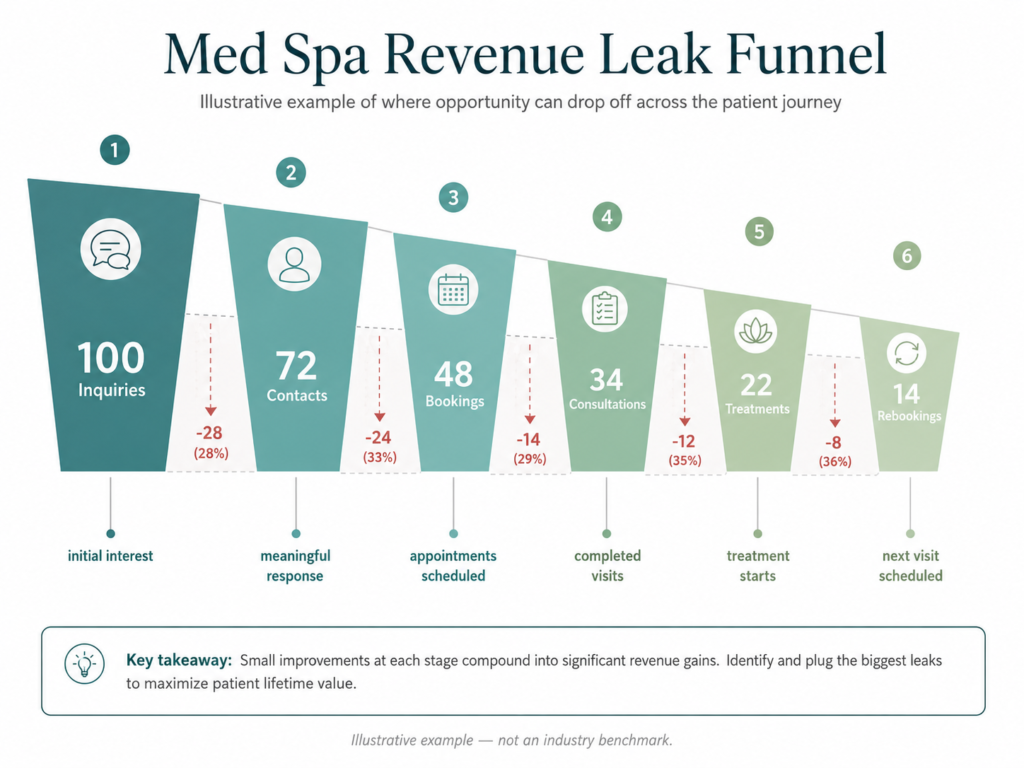
Those numbers are illustrative, not a benchmark. They show that the business did not lose 82 opportunities in one place. It lost them across several handoffs.
Each drop requires a different fix:
-
- Low lead volume: visibility, targeting, positioning, or offer.
-
- Low contact rate: speed, staffing, channel coverage, or bad data.
-
- Low booking rate: conversation quality, availability, or scheduling friction.
-
- Low show rate: confirmation, reminders, or unclear expectations.
-
- Low consultation conversion: fit, trust, communication, or treatment planning.
-
- Low rebooking and retention: patient experience, next-step clarity, or follow-up.
“Get more leads” only addresses the first problem.
Pouring more leads into a leaky system does not create predictable growth. It creates more expensive waste.
2. Are Your Leads Being Followed Up With Effectively?
A lead is most valuable while the person’s interest is active. If an inquiry sits overnight, gets buried in a social inbox, or receives one missed call and no second attempt, you may blame the ad when the failure happened after the lead arrived.
A large cross-industry study of 1.25 million leads found that organizations attempting contact within an hour were nearly seven times as likely to qualify the lead as those waiting even one hour longer. It was not med-spa-specific, so it is not a medical-spa benchmark. It does support a practical principle: speed and process matter while intent is fresh. [1]
A functioning follow-up system should make six things clear:
-
- Where every inquiry lands.
-
- Who owns it during and after business hours.
-
- How quickly a real response is expected.
-
- How many appropriate attempts are made.
-
- How the prospective patient can book easily.
-
- What status and next action belong to every open lead.
If nobody owns follow-up, follow-up is a hope not a system.
Track median first-response time, contact rate, follow-up completion, and booking rate by source. An automatic acknowledgment is useful, but it is not a real conversation.
3. Are Consultations Becoming Appropriate Treatment Starts?
Getting someone through the door is not the same as creating a patient relationship. A consultation can fail even when the provider is clinically excellent.
The conversation may jump to price before anyone understands the patient’s goals. The provider may act like an order taker instead of giving a clear professional recommendation. The patient may receive a menu of options but no prioritized plan. Or the patient may say, “I need to think about it,” and never hear from the practice again.
Consultation conversion is not about pressure. It is about helping an appropriate patient make an informed, confident decision. Sometimes the right outcome is no treatment. That builds trust, too.
A repeatable process should help the team:
-
- Prepare before the patient arrives.
-
- Understand the patient’s goals, concerns, timing, and prior experiences.
-
- Explain suitable options and realistic expectations in plain English.
-
- Recommend a clear and prioritized next step.
-
- Schedule that next step when appropriate.
-
- Follow up with interested patients who were not ready to proceed.
Track consultation show rate, consultation-to-treatment rate, time from consultation to treatment, and results by provider and service.
When performance differs, inspect patient mix, service mix, scheduling, communication, and documentation before blaming a person.
4. Are Patients Coming Back?
New-patient acquisition gets attention because it is visible. Retention is quieter. It is also where growth compounds or stalls.
A first treatment is not a retention system. Neither is assuming satisfied patients will remember when to return. People get busy, lose track of timing, try another provider, or wait because nobody made the next step clear.
Retention should begin before the patient leaves. Confirm the clinically appropriate next step, offer rebooking, send thoughtful post-visit follow-up, schedule reminders based on the treatment plan, and reactivate patients who become overdue.
Do it without encouraging unnecessary treatment.
A Cochrane review of healthcare appointments found that text-message reminders improved attendance compared with no reminders. The evidence was not med-spa-specific and was rated low to moderate in quality, but it reinforces the basic point: a systematic reminder process reduces dependence on memory. [2]
Retention still has to be earned through trust, appropriate care, communication, consistency, and a strong patient experience. A CRM cannot compensate for a poor experience. But a good experience without follow-up still leaves growth to chance.
Track:
-
- Rebooking rate.
-
- Return within the expected treatment or maintenance window.
-
- Time to second visit.
-
- Patient lifetime value.
-
- Reactivation rate.
-
- Referral source.
5. Are You Measuring Activity Instead of Business Results?
A full calendar can hide a stagnant business. High lead volume can hide weak conversion. Revenue can rise while efficiency or margins deteriorate.
Followers, impressions, clicks, and reach show that activity occurred. They do not show whether the practice created profitable, repeatable patient revenue.
American Med Spa Association business guidance identifies total production, capacity percentage, revenue per working hour, and revenue per appointment as important medical-spa KPIs. Put those measures beside the patient-journey metrics that reveal revenue leaks. [3]
| Stage | What to measure | What it tells you |
| Demand | Qualified leads by source; cost per qualified lead | Whether you attract the right people |
| Response | Median response time; contact rate | Whether you reach people while intent is active |
| Booking | Booked consultations ÷ qualified leads | Whether booking is easy and effective |
| Attendance | Completed consultations ÷ bookings | Whether confirmation and reminders work |
| Consultation | Treatment starts ÷ completed consultations | Whether appropriate patients receive clear recommendations |
| Treatment | Revenue per appointment; provider capacity | Whether the schedule creates enough value |
| Rebooking | Eligible patients rebooked | Whether each visit ends with a next step |
| Retention | Repeat visits; patient lifetime value | Whether relationships are compounding |
| Referral | New patients attributed to referrals | Whether patients become advocates |
Define each metric consistently. Compare it over time and by source, provider, service, and location when relevant.
Do not let a random internet benchmark replace your own baseline and context.
Vanity metrics are not useless. They are simply too far upstream to run the business.
6. Are You Trying to Solve a Systems Problem With More Marketing?
Marketing can improve visibility, reach better prospects, strengthen the message, and generate qualified inquiries.
Marketing cannot answer missed calls. It cannot make the front desk complete follow-up. It cannot repair a rushed consultation, book the next appointment, reactivate a dormant database, or create accountability where nobody owns the work.
You likely have a marketing problem when:
-
- Qualified inquiry volume is insufficient.
-
- Targeting is attracting the wrong people.
-
- Local visibility is weak.
-
- Cost per qualified lead is rising while downstream conversion remains stable.
You likely have a systems problem when inquiries arrive but contact, booking, attendance, treatment starts, rebooking, or retention are weak.
You may have both.
Fix the first constraint that materially limits revenue.
Here is the uncomfortable truth: you can keep calling it a marketing problem. Your profit-and-loss statement will keep recording it as lost revenue.
How to Find Your Med Spa’s Growth Bottleneck
1. Define each stage
Agree on what counts as a qualified lead, meaningful contact, booking, completed consultation, treatment start, rebooking, retained patient, and referral.
Do not allow each employee, provider, or software platform to use a different definition.
2. Pull 60–90 days of data
Calculate the handoff rate at every stage. Do not stop at total leads or total revenue.
A shorter period may work for a high-volume practice. A lower-volume practice may need a longer window.
3. Segment the results
Compare performance by:
-
- Lead source.
-
- Service.
-
- Provider.
-
- Location.
-
- Day and time.
-
- New versus returning patient.
Only segment when the volume is large enough to be useful.
4. Inspect real examples
Numbers tell you where to look. Real interactions help explain why the problem is occurring.
Review calls, texts, messages, lost leads, cancellations, no-shows, unconverted consultations, and patients who failed to rebook.
5. Find the earliest material drop
An upstream leak usually affects every stage after it.
For example, improving consultation follow-up will not recover inquiries that were never contacted. A retention campaign will not repair a booking process that prevents people from entering the practice.
6. Assign one owner and improve one bottleneck
Set a clear standard, decide who owns it, measure the result for 30 days, and then move to the next constraint.
Do not launch five fixes at once. You will create motion and lose the ability to tell what worked.
Frequently Asked Questions
Can a busy med spa still fail to grow?
Yes. Busy providers can coexist with low revenue per appointment, poor rebooking, weak retention, scheduling inefficiency, or declining profitability. Busyness is a capacity signal, not proof of healthy growth.
How do I know whether my med spa needs more leads?
You need more leads when current qualified inquiries are being contacted, booked, converted, and retained at a consistently managed level and unused capacity remains. When those stages are weak or unmeasured, fix the leak before buying more traffic.
Which growth metric should I fix first?
Start with the earliest meaningful drop that has enough volume to matter and a cause you can control. Fixing an upstream leak usually improves every stage that follows.
Should I change marketing agencies if revenue is flat?
Not until you trace the numbers. Separate lead quality and acquisition cost from response, booking, attendance, consultation, rebooking, and retention.
The agency may be underperforming. The internal system may be underperforming. Or both may be true.
Before You Spend More, Find the Break
Before you spend more money trying to generate more patients, find where your existing revenue opportunity is being lost.
Write this on a whiteboard:
Leads → Response → Booking → Consultation → Treatment → Rebooking → Retention → Referral
Put your actual numbers under every stage. Then ask:
Where does our patient journey break down?
Growth becomes less mysterious when every handoff is visible, measured, and owned. Systems create success because systems make performance repeatable.
Your next move is not more activity.
It is an honest diagnosis and one disciplined fix.