
Should You Open Your Own Med Spa?
You should open your own med spa only if you want the job of ownership—not simply more freedom from your current job—and the market, economics, legal structure, capital, and personal risk all make sense. Being a talented injector, having loyal patients, or feeling ready for “the next level” can create the opportunity to own. None of those things automatically make ownership the right move.
Before you sign a lease, buy a laser, form a company, or give notice, run the decision through the OWNER Decision Test: Outcome → Work → Numbers → Eligibility → Risk.
| The uncomfortable questionWould you still want the practice if you had to spend less time injecting and more time dealing with payroll, cash flow, hiring, compliance, marketing, systems, vendors, difficult decisions, and problems that nobody else can hand back to the owner? |
Ownership Is Not a Promotion. It Is a Career Redesign.
A provider can be booked out, respected, clinically strong, excellent at consultations, and still discover that they do not enjoy running a business. That is not failure. It is information.
The owner role adds responsibilities that do not disappear because the treatment room is busy: hiring, payroll, pricing, cash flow, marketing, vendor contracts, legal structure, compliance, technology, team management, patient experience, forecasting, and difficult decisions when the numbers do not cooperate.
That is why the real first question is not “Can I open?” It is “Do I want the work that comes after opening?”
Do You Want Ownership—or Do You Want More Control?
Sometimes “I want my own med spa” actually means:
- I want more control over my schedule.
- I want better compensation.
- I want more say in patient experience and standards.
- I want leadership responsibility.
- I want to build something with my name on it.
- I am frustrated with how my current practice is run.
Those are legitimate goals. But full ownership is only one way to pursue them. Depending on your situation, a leadership role, better compensation structure, management responsibility, partnership opportunity, or a move to a better-fit practice may solve the real problem with less capital and risk.
Do not buy a business because what you actually need is a better job.
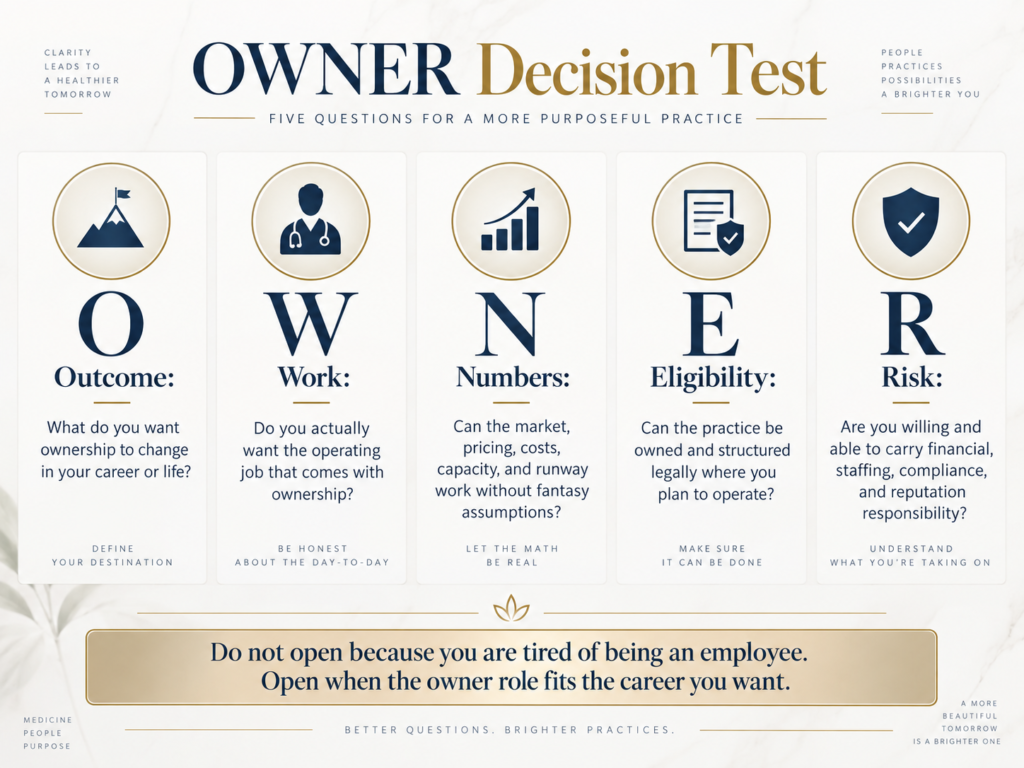
O — Outcome: What Do You Want Ownership to Change?
Write down the answer before you build a spreadsheet.
Good ownership motives tend to be specific: creating a particular patient experience, building a durable company, making strategic decisions, developing a team, or building an asset over time. Weak motives tend to depend on ownership magically solving something it may actually intensify: stress, lack of time, income pressure, difficult people, or the desire to “be your own boss.”
Ask yourself:
- If the business took longer than expected to become stable, would I still want to own it?
- Do I want to build a team, or do I mainly want a room where I can inject independently?
- Do I want responsibility for the entire patient experience—or only the clinical part I personally control?
- Is ownership part of a long-term plan, or a reaction to a bad month at work?
W — Work: Do You Want the Owner Job?
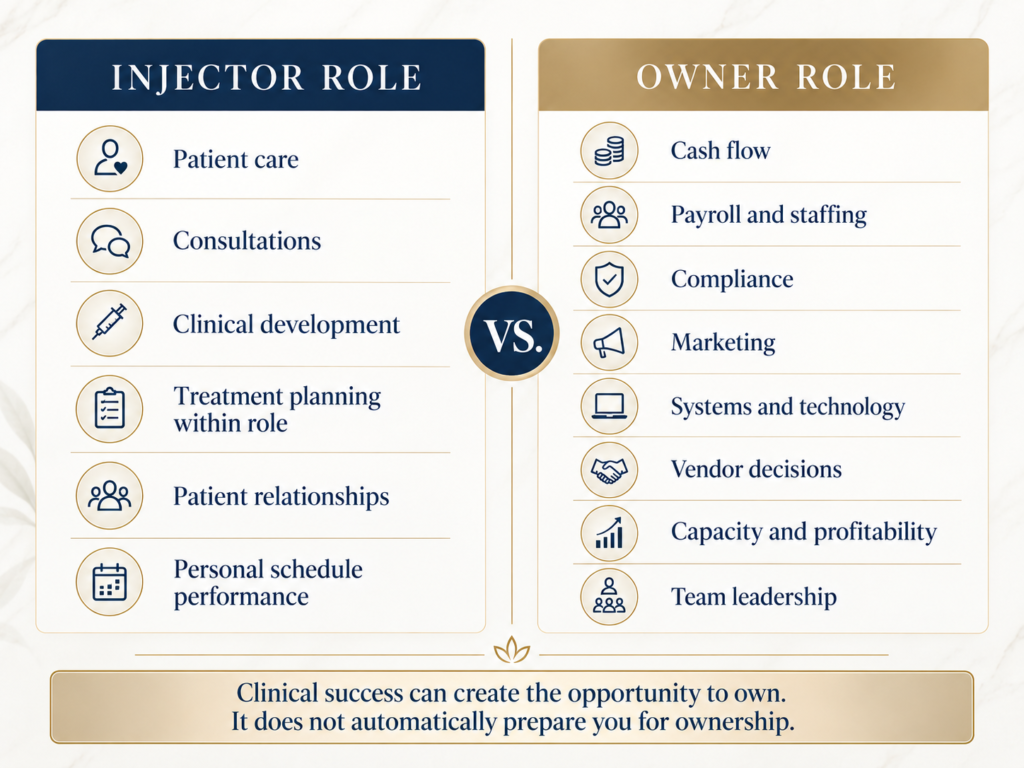
The fastest way to romanticize ownership is to imagine the finished clinic instead of the operating work.
An owner may need to decide what happens when:
- Revenue is lower than forecast but payroll is still due.
- A key employee leaves.
- A vendor contract is wrong for the business.
- Marketing produces inquiries but the front desk is not converting them.
- A compliance question affects how the practice can operate.
- The schedule is full but cash flow is tight.
- A team member needs coaching, documentation, or a difficult conversation.
You do not have to know how to solve every problem today. You do need to want to become the person who builds systems, finds qualified advisors, makes decisions, and owns the consequences.
Clinical excellence can create the opportunity to own. It does not replace the owner job.
N — Numbers: Can the Market and Economics Work?
Before you fall in love with a location, equipment package, or brand concept, complete market research and competitive analysis and build a real business plan. The U.S. Small Business Administration specifically recommends using market research to understand customers and competition and using a business plan as a roadmap for how the business will be structured, run, funded, and grown. [1]
For a future med spa owner, that means answering questions such as:
- Who is the target patient—and is there evidence they exist in the market?
- Which services fit the patient, provider capability, legal environment, and financial model?
- What will rent, buildout, equipment, supplies, insurance, professional fees, payroll, technology, marketing, and working capital realistically cost?
- How much unused capacity is likely at the beginning?
- How will the business acquire and retain patients without depending on one launch event?
- What happens to the plan if revenue develops more slowly than hoped?
The SBA recommends identifying both one-time and monthly startup costs before launch and using those costs to understand the amount of capital the business may require. [1] It also provides a break-even analysis framework based on fixed costs, pricing, variable costs, and projected sales. [2]
Do not use an internet headline such as “you can open a med spa for $X” as your financial plan. Real costs vary dramatically by location, buildout, staffing, equipment strategy, service mix, legal structure, insurance, and how much runway you need.
| A better question than “How much does a med spa cost?”How much capital does this specific plan require to open legally, operate safely, market responsibly, cover monthly obligations, and survive a slower-than-expected ramp? |
Do Not Confuse Revenue With Owner Income
A practice can collect significant revenue and still have weak cash flow. Equipment payments, payroll, rent, supplies, merchant fees, marketing, software, professional fees, insurance, taxes, debt service, refunds, and other obligations all compete for that revenue.
Build the financial model around cash movement and operating assumptions—not the size of the top-line number you hope to post on social media.
E — Eligibility: Can You Legally Own and Structure the Practice?
This question belongs near the beginning—not after the lease is signed. General small-business guidance explains that business structure affects taxes, fundraising, paperwork, and personal liability, while the IRS separately explains the federal tax treatment of common business structures. [3][4]
A medical spa adds another layer: medical-practice ownership, delegation, supervision, and entity rules can vary by state and by professional license.
The American Med Spa Association’s overview of medical spa legal requirements notes that the permitted legal structure can depend on the licenses of the owners and the laws of the state. [5] Its discussion of the corporate practice of medicine explains that some states restrict non-physician ownership or control of medical practices. [6]
That is why there is no reliable nationwide answer to “Can an RN own a med spa?” or “Can an NP own a med spa?” The correct answer depends on the jurisdiction, the ownership model, the professional licenses involved, and the services being provided. State rules can also change; AmSpa highlighted in 2026 that new state legislation can affect ownership, supervision, and who may perform certain aesthetic services. [7]
Before committing money, obtain advice from a healthcare attorney familiar with the state in which the practice will operate and qualified tax/accounting guidance for the proposed entity and ownership arrangement.
An LLC filing is not a substitute for determining whether the medical practice itself is legally structured.
A Med Spa Is Also a Regulated Marketing and Privacy Environment
Ownership means accepting responsibility for more than the clinical room. Advertising, patient images, reviews, claims, privacy, records, and patient communications all need appropriate systems and qualified guidance.
The Federal Trade Commission’s health-products advertising guidance emphasizes that health-related advertising must be truthful, not misleading, and appropriately substantiated. [8] If the practice is a HIPAA covered entity, HHS HIPAA marketing guidance explains that using or disclosing protected health information for marketing generally requires authorization, subject to limited exceptions. [9]
This is not a reason to avoid ownership. It is a reason to understand that “I can inject” and “I can operate a compliant medical business” are different competencies.
R — Risk: Can You Carry the Downside?
Ownership gives you control over more decisions. It also gives you responsibility for more outcomes.
Think beyond the best-case forecast. Ask:
- What if buildout runs over budget?
- What if opening is delayed?
- What if patient acquisition is slower than expected?
- What if one provider produces a disproportionate share of revenue?
- What if you cannot pay yourself what you expected for several months?
- What debt, guarantees, or investor obligations would still exist if the business underperformed?
- How much personal financial stress can you tolerate without making desperate business decisions?
Risk tolerance is not bravery. It is the ability to understand the downside, reduce avoidable risk, fund the remaining risk appropriately, and still make rational decisions when the business is under pressure.
Signs Ownership May Fit You
- You want to build and operate a company—not merely create your own treatment schedule.
- You have a clear reason for ownership that still makes sense after the glamour is removed.
- You are willing to learn finance, leadership, marketing, operations, compliance, and systems.
- You can validate a market rather than assuming your current patients will automatically follow.
- You are building a written financial model with realistic startup costs and operating runway.
- You are willing to get state-specific legal and tax advice before committing capital.
- You can tolerate uncertainty without needing the business to rescue your personal finances immediately.
Reasons to Pause Before Opening
- Your main reason is frustration with your employer.
- The plan depends on every current patient following you.
- You have not researched whether your ownership structure is legal in your state.
- You are buying equipment before validating demand and the financial model.
- You are treating projected revenue as personal income.
- You do not have enough capital for the business to underperform the launch forecast.
- You enjoy injecting but strongly dislike hiring, numbers, operations, or managing people.
- You believe ownership will automatically create more free time.
“Not yet” is a legitimate ownership decision. It may mean you need more savings, more leadership experience, a stronger patient following, clearer legal guidance, better business knowledge, or a more viable market.
Before You Sign a Lease, Create a One-Page Ownership Decision File
You do not need a 60-page business plan to decide whether the idea deserves deeper work. Start with one page containing:
- The career outcome you want ownership to create.
- The owner responsibilities you are willing to accept.
- The target patient and evidence of demand.
- The proposed service and revenue model.
- Estimated one-time startup costs.
- Estimated monthly fixed and variable costs.
- A conservative break-even and cash-runway scenario.
- The state-specific ownership and entity questions requiring legal confirmation.
- The major risks that could make you pause.
- The next decision: GO, INVESTIGATE FURTHER, or NOT YET.
Only after the decision survives that page should you move deeper into location, financing, equipment, staffing, marketing, and launch planning.
Frequently Asked Questions
Is owning a med spa profitable?
It can be, but there is no universal profitability guarantee or reliable single margin that applies to every practice. Profitability depends on pricing, volume, service mix, labor, rent, equipment, supplies, marketing efficiency, financing, capacity, retention, management, and many other operating factors. Build projections from your own assumptions and test them against conservative scenarios.
How much money do I need to open a med spa?
There is no responsible universal dollar amount. The SBA recommends calculating the specific one-time and monthly startup expenses for the business and using those figures to understand capital requirements. [1] For a med spa, costs may include legal and professional fees, licenses, insurance, rent and buildout, equipment, technology, inventory and supplies, payroll, marketing, and working capital.
Can an RN, NP, or PA own a med spa?
There is no national yes-or-no answer. Medical-practice ownership rules vary by state, entity type, license, and arrangement. Some states restrict ownership or control under corporate-practice-of-medicine rules, while other states permit different structures. Obtain state-specific healthcare legal advice before relying on any general internet answer. [5][6][7]
Do I need a medical director?
That depends on the state, entity structure, services, provider licenses, delegation and supervision requirements, and who is legally responsible for medical care. Do not assume that adding a “medical director” title automatically makes an otherwise noncompliant structure legal. A healthcare attorney should evaluate the specific model.
Should I quit my job before starting the business?
Not automatically. Leaving employment is a separate financial and career decision. Build the business model, understand contractual obligations, verify legal structure, estimate capital requirements, and decide how much personal runway you need before giving up stable income.
Should I start a med spa or buy an existing one?
Both paths can work, and both require due diligence. Starting gives you more control over the initial concept and systems but requires building demand and operations. Buying may provide existing revenue, staff, equipment, records, and patients, but it also means evaluating liabilities, quality of earnings, contracts, compliance, reputation, equipment condition, and whether the business is transferable. This deserves its own analysis before a decision.
What if I want more autonomy but I am not sure I want ownership?
That is an important answer, not a problem. Explore whether leadership, management responsibility, a better compensation model, a compliant partnership opportunity, or a different practice environment would create the autonomy you want without requiring you to own the entire business.
Ownership Should Be Chosen, Not Assumed
A successful injector does not owe anyone a med spa.
You can build an extraordinary career as an employee, leader, educator, partner, manager, or owner. The question is which role gives you the work, responsibility, upside, and life you actually want.
Run the decision through OWNER:
- Outcome.
- Work.
- Numbers.
- Eligibility.
- Risk.
If those pieces align, ownership may deserve serious planning. If one of them does not, do not hide the problem under a beautiful logo, expensive device, or signed lease.
The right time to discover that you do not want the owner job is before you buy the owner problems.
| EXPLORE RESOURCESExplore Injector Success resources for practice ownership, funding preparation, business planning, marketing, leadership, financial literacy, and intentionally building the next stage of your aesthetic career. |