
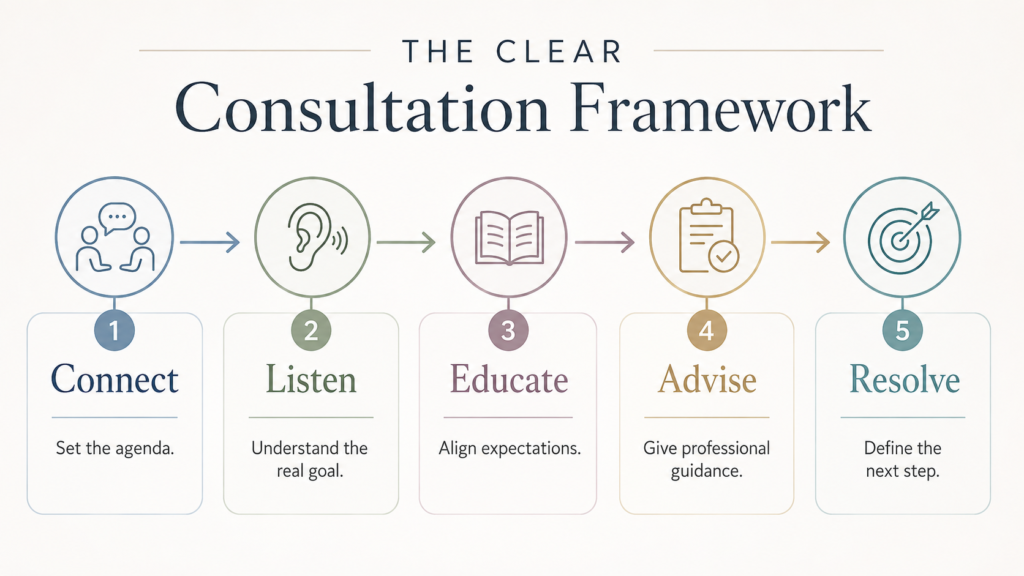
A great aesthetic consultation is a structured decision-making process that helps the provider understand the patient, identify the real goal, assess suitability, align expectations, explain appropriate options, provide professional guidance, and leave the patient with a clear next step.
Sometimes that next step is treatment.
Sometimes it is more information.
Sometimes it is time to think.
Sometimes it is no treatment at all.
That is why consultation skill should not be reduced to “closing.”
The makes a similar point from the perspective of aesthetic nursing: the clinical conversation is a fundamental part of aesthetic practice rather than something to rush past on the way to the procedure. [1]
The framework is:
Come Prepared → Open and Listen → Name the Goal → Screen for Safety and Suitability → Unpack Options and Expectations → Lead With a Recommendation → Tie Up the Decision
The CONSULT Framework.
A Consultation Is Not the Conversation Before the “Real” Appointment
Providers spend enormous time developing technical ability.
That should happen.
But technical ability answers only one question:
Can you perform the procedure appropriately?
The consultation has to answer several others.
What is the patient actually trying to accomplish?
Why now?
What previous experiences are shaping their expectations?
Is the requested intervention appropriate?
Does the patient understand the limitations?
Are there reasons not to proceed?
Does the patient understand their options?
Are you recommending something because it makes sense—or simply because the patient requested it?
A 2025 study examining found that an empathetic practitioner attitude and precise explanations were among the most highly valued consultation characteristics. [2]
That study included only 104 patients at one university hospital and was focused on plastic surgery rather than injectable practice.
Still, the broader lesson is useful:
Patients are evaluating more than what you can technically do. They are evaluating how you help them make the decision.
C — Come Prepared
A consultation starts before you say hello.
Preparation might include reviewing whatever appropriate information your practice has already collected, such as:
- Reason for visit.
- Relevant history.
- Previous aesthetic experiences.
- Existing photographs where appropriate.
- Prior notes.
- Patient questions.
- Practice-specific intake information.
The exact medical screening process should follow your role, professional requirements, product information, employer protocols, and jurisdiction.
The goal is not to make a clinical decision before meeting the patient.
It is to avoid beginning the consultation completely cold.
If the patient wrote:
“I’m nervous because I had a bad experience elsewhere.”
and your first question is:
“So what brings you in?”
you just told them the intake form did not matter.
Preparation communicates attention before the conversation even begins.
O — Open and Listen
Do not begin by pointing out everything you could treat.
Begin with the patient.
Try:
“What would you most like us to talk about today?”
Then listen.
The found that qualifications and training were the most important trust factor among respondents, followed by practitioner reputation and time spent. The broader study also identified listening and empathy as important elements of rapport. [3]
Broader healthcare evidence points the same direction.
A 2026 systematic review of found that clear information delivery, empathy, active listening, shared decision-making, and supportive nonverbal communication were generally associated with greater patient trust. [4]
That research is not injectable-specific.
But it reinforces an important consultation principle:
You cannot conduct a patient-centered consultation if the provider does most of the talking.
N — Name the Goal and Motivation
A patient says:
“I want filler.”
That is a requested treatment.
It is not necessarily the goal.
The goal might be:
“I look tired in photographs.”
Or:
“I want to feel more like I did a few years ago.”
Or:
“My friend had this done and I think I need it too.”
Or:
“I have an event coming up.”
Those are very different conversations.
The patient-centered recommends developing a broader understanding of the patient’s concerns, lifestyle, relevant history, treatment goals, attitudes toward treatment, and other factors before constructing a plan. [5]
That model is based partly on literature, expert clinical experience, and industry-supported survey material, so it should be treated as practice-oriented expert guidance rather than high-level causal evidence.
But its central principle is sound:
The requested procedure and the patient’s actual objective are not always the same thing.
Do Not Assume You and the Patient See the Same Problem
A large global survey comparing patient and physician perspectives on found meaningful differences in what patients and clinicians emphasized.
Patients also placed more emphasis than physicians on some concerns surrounding safety, injections or procedure-related discomfort, and unnatural-looking results. [6]
That should change the consultation.
Instead of assuming:
“I know what bothers them.”
ask.
Instead of assuming:
“I know why they’re hesitant.”
ask.
Instead of assuming:
“Price is the problem.”
ask.
Expertise should reduce assumptions—not make you more confident in them.
S — Screen for Safety and Suitability
A great consultation is not only about discovering what the patient wants.
It also determines whether proceeding makes sense.
The exact clinical assessment belongs to appropriately qualified professionals and should follow applicable scope, licensure, supervision requirements, practice protocols, product information, and local law.
At a high level, consultation protocols commonly need to address things such as:
- Relevant health and treatment history.
- Prior aesthetic experiences.
- Suitability for the treatment being considered.
- Expectations.
- Ability to understand the decision.
- Concerns that warrant additional assessment.
- Reasons treatment should be postponed or declined.
One area deserving particular attention is body-image concern.
An evidence review on identified several screening tools used in aesthetic populations while also concluding that further research is needed to determine the best standardized approach for general aesthetic practice. [7]
This does not mean an injector should diagnose a psychiatric disorder from a questionnaire.
It means cosmetic-treatment suitability sometimes requires recognizing when an appearance concern deserves more evaluation rather than more treatment.
Follow the protocols appropriate to your professional role and practice.
A Good Consultation Must Leave Room for “No”
This is where consultation quality separates itself from consultation salesmanship.
If every conversation has to end in treatment, your decision-making is already biased.
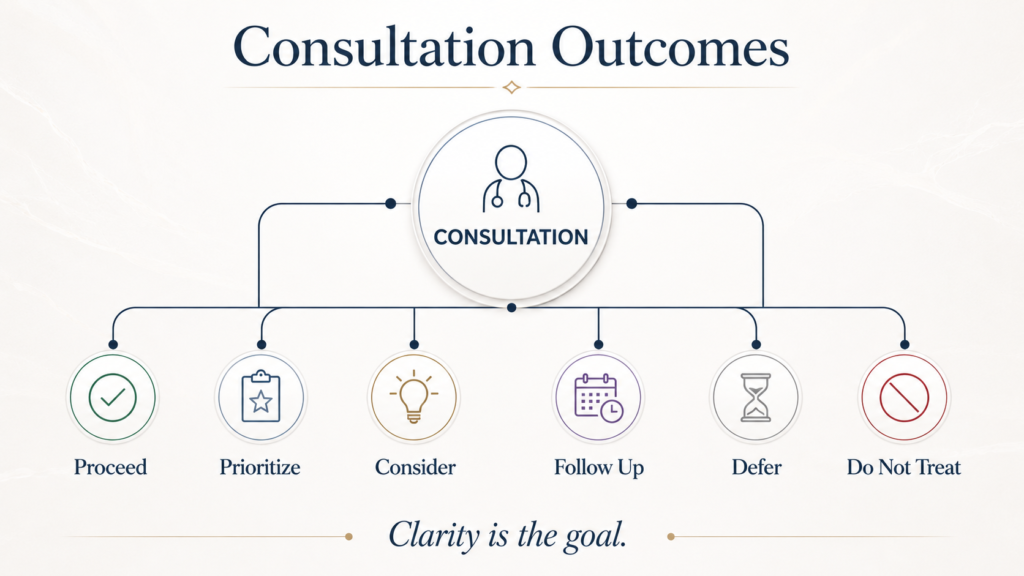
A valid consultation outcome can be:
Yes.
Not yet.
Let’s gather more information.
Let’s reconsider the goal.
This option does not make sense for you.
No treatment today.
The provider is not there simply to approve the patient’s order.
Nor is the provider there to invent new insecurities until something sells.
A consultation that converts at the expense of suitability is not a great consultation.
U — Unpack Options and Expectations
Once you understand the patient and have established that it is appropriate to continue the discussion, move from discovery into education.
This is where patients should begin understanding:
- What options are appropriate to discuss.
- What each option is intended to accomplish.
- Meaningful limitations.
- Relevant trade-offs.
- Expected course.
- Appropriate alternatives.
- What no treatment might mean.
- What outcomes should not be promised.
The goal is not to unload everything you know.
The goal is to give the patient what they need to make an informed decision.
The Agency for Healthcare Research and Quality defines as a collaborative process combining available evidence and professional expertise with the patient’s goals, values, preferences, and circumstances. [8]
AHRQ’s organizes that process around inviting participation, exploring options, assessing what matters to the patient, reaching a decision together, and evaluating the decision. [8]
Aesthetic care is not identical to primary care.
But the decision principle transfers well:
The provider contributes professional judgment.
The patient contributes goals, preferences, and consent.
You need both.
Education Should Clarify, Not Overwhelm
One mistake is saying too little.
Another is proving how much you know for 20 uninterrupted minutes.
Watch for the patient who has stopped processing.
Ask:
“Does that make sense so far?”
Or:
“What questions does that bring up for you?”
Patient education can also begin before the live provider conversation.
A quality-improvement project involving new cosmetic-injection patients found that adding a pre-procedure educational video alongside provider consultation was associated with improved patient confidence and satisfaction and reduced provider consultation time. [9]
That was one quality-improvement project, not proof that every practice needs a video or that the same result will occur everywhere.
The more durable lesson is:
Standardized education can support the consultation. It should not replace the conversation.
Realistic Expectations Are Part of the Treatment Plan
Do not wait until after treatment to discover that you and the patient had different definitions of success.
Explore expectations before the decision.
Useful questions may include:
“What change would feel worthwhile to you?”
“What are you hoping does not change?”
“What would disappoint you?”
“Are you looking for something subtle or something more noticeable?”
“Is there a result you’ve seen that represents what you’re imagining?”
These questions are not a substitute for clinical assessment.
They expose whether the provider and patient are discussing the same outcome.
The 2025 first-consultation study found that precise explanations were highly valued by patients. [2]
Clarity before treatment is easier than repairing an expectation gap afterward.
Informed Consent Is More Than a Signature
The consultation and informed-consent process overlap, but they are not interchangeable.
For physicians, the AMA’s describes informed consent as a communication process in which patients receive relevant information, can ask questions, and make an informed and voluntary decision. It includes discussing the nature and purpose of the intervention, relevant risks, expected benefits, alternatives, and the option of forgoing treatment. [10]
That is physician-specific ethical guidance, not a universal legal rule for every aesthetic professional.
Consent requirements vary by profession, treatment, jurisdiction, and practice.
But the fundamental distinction is worth preserving:
A signed form proves a form was signed. It does not prove the patient understood the conversation.
L — Lead With a Recommendation
The provider should not disappear from the decision.
Listening is not the same as order taking.
Shared decision-making does not mean:
“Whatever you want.”
The patient brings their priorities.
The provider brings professional knowledge and judgment.
A useful recommendation explains:
What you recommend.
Why.
What it can reasonably accomplish.
What it cannot.
What you are not recommending.
What the patient should understand before deciding.
That may sound like:
“Based on what you’ve told me your priority is, this is the option I think makes the most sense to discuss first, and here’s why.”
Notice what that does not sound like:
“You need five things you didn’t ask about.”
A strong recommendation creates direction without manufacturing insecurity.
Prioritize Instead of Dumping a Shopping List
A patient may have several appropriate options.
That does not mean you should present everything with equal urgency.
Consider:
Priority one.
Potential future consideration.
Optional.
Not recommended.
That gives the patient structure.
It also communicates that every visible imperfection does not automatically require treatment.
One of the most valuable things an aesthetic provider can say is:
“You don’t need to do that.”
Patients remember restraint.
T — Tie Up the Decision and Next Step
A surprisingly good consultation can still end poorly.
Everyone talks.
The patient receives useful information.
Then:
“Okay, well, let us know.”
And the patient leaves uncertain about what happens next.
End deliberately.
Depending on the consultation outcome, confirm:
- What was decided.
- What remains undecided.
- Whether additional information is needed.
- What appropriate next step exists.
- What questions remain.
- How the patient should contact the practice.
- What follow-up the practice will provide.
Again, the outcome might be:
Proceed.
Pause.
Reconsider.
No treatment.
Clarity is the goal.
The Great-Consultation Test
Before ending, ask yourself:
Did I understand the patient?
Not simply the requested treatment.
The person, goal, concern, and expectation.
Did I assess whether moving forward was appropriate?
Using the professional and practice protocols applicable to me.
Did the patient understand the options?
Not just hear them.
Did I identify expectation gaps?
Before—not after—the decision.
Did I make a recommendation?
Rather than leaving the patient to interpret a menu.
Did the patient have room to say no?
Without pressure.
Does everyone know what happens next?
If not, the consultation is not finished.
Do Not Measure Consultation Quality Only by Conversion Rate
Practices need business metrics.
A med spa consultation conversion rate can tell you how often consultations become treatment.
That makes it useful.
It does not make it a quality score.
Imagine two providers.
Provider A
Treats almost everyone.
Provider B
Sometimes says:
- Not appropriate.
- Not yet.
- Your expectation and this treatment do not match.
- You do not need this.
Which one delivers better consultations?
You cannot answer from conversion rate alone.
Track commercial performance where appropriate.
But remember:
The goal is not maximum conversion. The goal is appropriate decisions made through an excellent consultation.
A high-quality “no” is better than a bad “yes.”
Frequently Asked Questions
What should happen during an aesthetic consultation?
A strong aesthetic consultation should generally help the provider understand the patient’s concern and goals, gather the appropriate information needed for assessment, evaluate suitability, discuss relevant options and expectations, provide professional guidance, support informed decision-making, and establish a clear next step.
Specific clinical and consent requirements depend on the treatment, provider role, practice, and jurisdiction.
What makes an aesthetic consultation good?
The strongest consultations combine preparation, listening, relevant assessment, realistic expectation-setting, clear education, professional judgment, patient participation, and an explicit next step.
Aesthetic and broader healthcare research consistently supports the importance of trust, empathy, listening, explanation, and patient participation. [2][3][4][8]
Should every consultation end with a treatment?
No.
A consultation may appropriately end with treatment, additional consideration, more information, a postponed decision, an alternative plan, or no treatment.
Making treatment the only acceptable outcome creates pressure that can interfere with appropriate professional judgment.
What questions should an injector ask during a consultation?
Questions should help clarify the patient’s concern, desired outcome, motivation, previous experience, expectations, priorities, and questions.
Clinical history and suitability questions should follow the protocols appropriate to the provider’s professional role and the treatment being considered.
How do you make an aesthetic consultation feel less salesy?
Listen before recommending.
Explain why an option fits the patient’s stated goal.
Prioritize recommendations instead of listing everything that could theoretically be treated.
Be willing to recommend less—or nothing.
How should aesthetic providers handle unrealistic expectations?
Do not promise an outcome you do not believe can reasonably be delivered.
Clarify the patient’s expectation, explain limitations, and determine whether the expectation can be appropriately aligned.
If significant body-image or psychological concerns arise, follow the screening, escalation, or referral process appropriate to your professional role and practice. Evidence reviews support the importance of recognizing BDD risk in aesthetic settings while also noting limitations in current screening evidence. [7]
Is consultation conversion rate important?
It can be a useful business metric, but it should never be treated as proof of consultation quality.
Measure whether appropriate patients move forward—but never create pressure to treat simply to improve the number.
The Consultation Is Where Judgment Becomes Visible
Patients cannot always evaluate technical skill before treatment.
But they can experience how you:
Listen.
Ask.
Explain.
Assess.
Set boundaries.
Recommend.
Respond to uncertainty.
Handle a no.
That means the consultation is one of the clearest places where professional judgment becomes visible.
Come prepared.
Open and listen.
Name the real goal.
Screen appropriately.
Unpack the options and expectations.
Lead with a recommendation.
Tie up the decision.
The best consultation is not the one where you convinced the patient to do something. It is the one where both of you understand why the next decision makes sense.
EXPLORE RESOURCES
Explore Injector Success resources for consultation strategy, patient communication, trust, professional recommendations, patient experience, and building the nonclinical skills that make an aesthetic provider more valuable.